Fish Factory Jobs Norway 2026
- base rate
- 228.65 NOK/h
- with experience
- +10-25 NOK/h
- no Norwegian needed
- English
- Legal minimum
- 225.96 NOK/h
- Typical rate
- 228.65–240.96 NOK/h
- Schedule
- Shift work
- Who can apply
- EU and EEA citizens
Arbeidstilsynet, verified · 2026-08-08
≈ €21–€22 · with our partner employers
37.5 h week · overtime at least +40 %
no visa or work permit needed
Short answer
In a Norwegian fish factory the legally enforceable minimum is 225.96 NOK an hour for production workers and 240.96 NOK for skilled workers. Our partner employers pay from 228.65 NOK an hour, and 10 to 25 NOK more if you can document food-processing experience. A standard month of 162.5 hours at the base rate comes to 37,156 NOK gross, and evening, Saturday and Sunday premiums come on top; how many hours you get depends on the plant. You need an EU or EEA passport. You do not need Norwegian.
What Norway fish factories actually pay
Unlike many agency postings, we show you the exact rates. Pay is based on the official Norwegian fish-processing industry tariff agreement (tariffavtale) 2025/2026 - nobody can pay less. Premiums are set by Norwegian labour law.
| Component | Rate / premium | Notes |
|---|---|---|
| Legal minimum, production worker | 225.96 NOK/hr≈ €20.60/hr | The floor set by Norwegian law since 15 June 2025. Nobody may pay you less. |
| What our partner employers pay | 228.65 NOK/hr≈ €20.83/hr | Above the legal floor, for every worker, no exceptions |
| Legal minimum, skilled worker (fagarbeider) | 240.96 NOK/hr≈ €21.96/hr | If you hold a recognised trade certificate in food processing |
| Bonus for 1+ year food-industry experience | +10 to +25 NOK/hr≈ €0.91-€2.28/hr | Depends on employer, skill level, and documentation |
| Night shift (22:00-06:00) | +20-25% | Norwegian labour law minimum |
| Saturdays after 13:00 | +50% | One-and-a-half rate |
| Sundays and public holidays | +100% | Double rate |
| Overtime (over 40h/week) | +50% | Collective agreement rate; the law guarantees at least +40% |
Verified 8 August 2026 · Source: Fiskeindustrioverenskomsten, Sjømat Norge and NNN
What is left after tax
A worked example on a standard month of 162.5 hours at the partner base rate, under the PAYE scheme most new arrivals start on.
- Gross month, 162.5 hours at 228.65 NOK
- 37,155 NOK
- PAYE tax, 25 percent
- -9,289 NOK
- Net in your account
- 27,866 NOK
- In euros
- ≈ €2,539
- Holiday pay accrued on top, 10.2 percent
- ≈ 3,790 NOK per year
PAYE is a flat 25 percent that already includes national insurance, and it is the scheme most first-year workers are put on. It caps at a yearly income limit, and you can opt into ordinary taxation instead if that works out better for you. Evening shifts, weekend premiums and overtime all raise these numbers. Check your own rate with Skatteetaten before you rely on it.
What is Fish Factory Work in Norway?
Norway is the world's second-largest seafood exporter after China - in 2025, exports hit a record 181.5 billion NOK. Fish processing employs over 12,000 people, and the industry recruits new workers from Europe every year - especially from Poland, Lithuania, Latvia, Estonia, and Germany.
Work mostly happens in 3 types of plants: salmon processing (year-round, most stable), white-fish processing (cod, halibut, monkfish), and pelagic processing (herring, mackerel). Each requires slightly different skills and has its own seasonality. There's also fishing boat work - physically harder but significantly better paid.
Job benefits
- Base rate 228.65 NOK/h at our partner plants, above the legal floor of 225.96 NOK
- Premiums for night shifts, Saturdays, Sundays
- No previous experience required - trained on site
- No Norwegian required (basic English needed for safety briefings)
- Accommodation arranged at 190 NOK a day (about 5,700 NOK a month), deducted from pay
- Norwegian social security and health coverage
- 25 annual leave days + 10.2% holiday pay
- Work year-round or seasonally - your choice
Your rights
What Norwegian law guarantees you, and how to check you are getting it
Some people have been badly treated in this industry, and news reports about it are easy to find. So here is what the law actually gives you, and how to verify each one yourself rather than take our word for it.
A minimum rate nobody can go under
Fish processing has a legally binding minimum of 225.96 NOK an hour for production workers and 240.96 NOK for skilled workers, in force since 15 June 2025. Your payslip must show your hourly rate and hours worked. Multiply them and compare. If the number is lower, the employer is breaking the law.
Check it yourself: ArbeidstilsynetRest between shifts is not optional
You are entitled to at least 11 hours of unbroken rest between shifts and 35 hours off in a row each week. A plant that rosters you through those hours is breaking the Working Environment Act, no matter what it says about the season being busy.
Check it yourself: Arbeidsmiljøloven §10-8Overtime carries a supplement of at least 40 percent by law
Unpaid overtime is illegal in Norway. The Working Environment Act sets the floor at 40 percent, and collective agreements in fish processing commonly pay 50. Either way, hours over the standard week must show separately on the payslip with the supplement applied.
Check it yourself: ArbeidstilsynetWhat can and cannot come out of your wage
Accommodation can be deducted if you agreed to it in writing. But money paid to reimburse your travel, board or lodging cannot be counted as part of your wage to make the hourly rate look legal. That rule is written into the regulation itself.
Check it yourself: Lovdata, FOR-2024-10-21-2542A written contract in a language you understand, before you travel
You should have the contract in your hands before you book anything. Read the rate, the hours, the accommodation deduction and the notice period. If someone wants you on a plane before you have seen it in writing, that is your signal to stop.
Nobody may charge you for a job, a tax card or a D-number
Recruitment fees charged to workers are prohibited. The skattekort and D-number are free and you apply for them yourself at the tax office. If anyone asks you for money for any of this, they are not doing you a favour.
Check it yourself: SkatteetatenWhere to complain if it goes wrong
The Labour Inspection Authority takes tips, including anonymous ones, and it inspects fish plants. The NNN union organises this industry and will help members with a wage dispute. Your embassy can help if your situation is worse than that.
Check it yourself: Arbeidstilsynet tip lineHoliday pay, sick pay, pension and injury cover
Holiday pay is 10.2 percent of your gross, paid the following year. Sick pay runs at full wage once you have been employed four weeks. The employer must pay at least 2 percent into a pension and must insure you against workplace injury from day one. None of this costs you anything.
The honest downsides
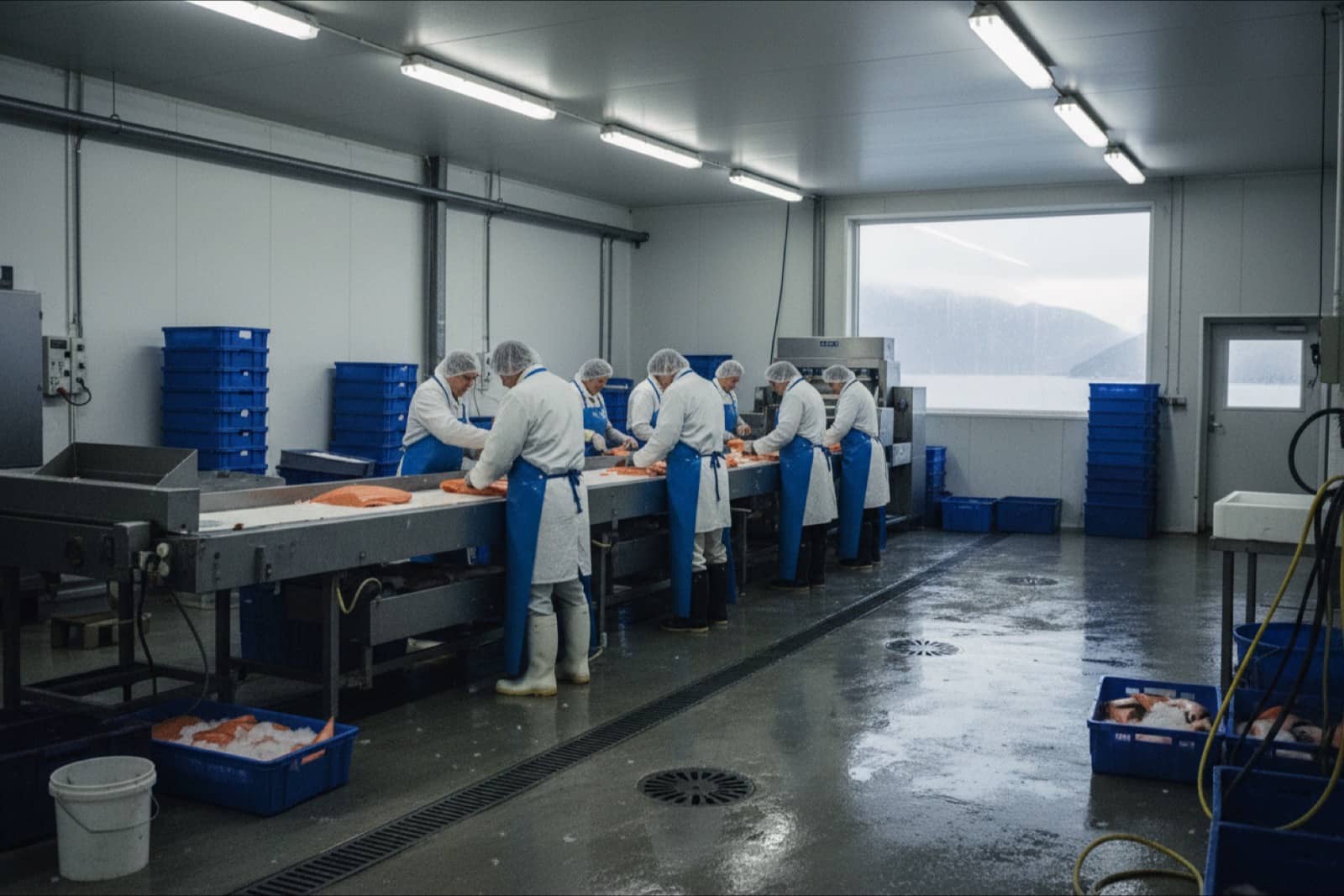
- The production hall sits at +4 to +8°C all day, because the fish requires it.
- You stand for the whole shift, and shifts run 8 to 12 hours in peak season.
- The work is repetitive. Some people find that restful, others cannot stand it.
- Senja is a small place. There is no city nightlife and the winter is dark.
- Work is tied to fish volumes, so hours can drop in a quiet week.
What we do, and what we are not
- We are not a staffing agency. We connect you with a Norwegian employer and your contract is with that employer, not with us.
- You never pay us anything. The employer covers our side.
- You see the rate, the accommodation cost and the shift pattern before you decide anything.
- We only place EU and EEA citizens, because that is who can work in Norway without a permit.
- If a plant is not treating you as described here, tell us and tell Arbeidstilsynet.
Fish factory job types
Norwegian fish factories process several species - farmed salmon goes through filleting, portioning and packaged products year-round. White fish (cod, halibut) is seasonal, including dried and salted klippfisk. Pelagic species (herring, mackerel) ship mostly to export markets. Larger plants run multi-shift operations year-round.
Not every role is open at every time of year - exact availability depends on season and partner factory. Get in touch to see what is currently open.
Salmon Processing
Salmon filleting, pin-boning, portioning, packaging. Year-round, stable employment.
White Fish (Cod, Halibut)
Cod (skrei) processing - January-April season in Lofoten. Filleting, salting, drying rack operations.
Packaging & Labeling
Vacuum-packing, weighing, labeling, palletizing. Often automated work.
Quality Control
Product quality checks, weight and size control, documentation. Attention to detail required.
Machine Operator
Operating filleting, cutting and packaging machines. Experience in mechanics or production is an advantage.
Fishing Boat Work
Work at sea on 2-4 week trips. Physically demanding and usually better paid than the factory, but with no statutory hourly floor. Seafarer medical certificate required.
Where exactly the fish factory jobs are
Most fish processing is concentrated in Northern Norway, in Nordland, Troms and Finnmark. The plants we place workers at are on Senja, next to Finnsnes. The rest of this list is the industry map, so you know where the fish goes and what each place is known for.
Tromsø
Largest city in Northern Norway - population 78,000. Year-round work: salmon, cod, halibut. Airport with direct flights to Oslo, London, and European hubs.
Finnsnes / Senja
Heart of salmon farming country. Year-round high demand. Smaller town, cheaper living, quieter environment.
Lofoten (Svolvær, Leknes)
The iconic cod (skrei) season January-April. 3-4 months of intense work, high wages, lots of overtime.
Vesterålen (Sortland, Andenes)
Fisheries and monkfish processing. Stable seasonal and year-round employment.
Båtsfjord
Far north - Norway's largest fish-landing port. Very high work volume, specific Arctic conditions.
Ålesund
West coast - the capital of pelagic fish (herring, mackerel) and klippfisk dried cod.
Who runs the plants on Senja
Naming the employers is the easiest way for you to check that this work is real. These are the processors operating in the area we recruit for.
| Company | Plant location | Species | Do we place workers here |
|---|---|---|---|
| SalMarInnovaNor | Silsand, Senja | Salmon | YesCompany site |
| NergårdNergård Senja | Senjahopen, Senja | Cod, Haddock, Saithe | NoCompany site |
| Br. KarlsenBr. Karlsen | Husøy, Senja | Salmon, Cod, Saithe | NoCompany site |
We do not place workers at every company listed. This table exists so you can see who is actually processing fish in the region and check us against them.
Requirements for fish factory jobs in Norway
Honest about what you'll need - and who this job isn't for.
This job fits if you…
- ✓You're 18+ with a valid EU/EEA passport or ID
- ✓You can physically stand and work 8-12 hours
- ✓You're OK with cold, wet rooms (+4 to +8°C)
- ✓You can work fast and rhythmically on a production line
- ✓You show up regularly and on time
- ✓You want an hourly rate set by law, with no education requirements
This job isn't for you if…
- ✗You have a strong allergy to fish or seafood
- ✗You can't stand for long periods (back or knee issues)
- ✗You don't tolerate cold or damp
- ✗You want an office job or flexible schedule
- ✗You can only wear regular clothes (work footwear mandatory)
- ✗You don't want to follow strict food-hygiene rules
What to bring: documents and items checklist
Everything you actually need. Nothing complicated - we sort most of it out together after your arrival in Norway.
1
Passport or EU ID card
Valid at least 6 months. EU/EEA citizens do not need a visa.
2
Skattekort (tax card)
Arranged after arrival in Norway. Until then, 50% tax is withheld - refunded later.
3
D-number or personal number
D-number for short-term work (<6 months), personal number for longer. We help with the application.
4
A1 certificate (optional)
From your home country's social security office. Valid up to 2 years - lets you pay contributions at home.
5
Bank account
You can use your home EU account with IBAN. A Norwegian account is an added option.
6
Work clothing and footwear
Most is provided by the employer. Bring: warm underwear, gloves, indoor slippers, good everyday shoes.
7
Medical certificate (rare)
Usually not required for factory work. Fishing-boat work requires a seafarer medical certificate.
8
CV and experience documents
If you have 1+ year in the food industry - contracts, references. Your native language is fine.
Skattekort: the Norwegian tax card, and how to get one
A skattekort is your tax deduction card, and your employer needs it before your first payslip. Without one, the employer must deduct 50 percent instead of your real rate, so this is worth sorting out in your first week.
You apply at a tax office in Norway with your passport and your employment contract. It is free. Most first-year workers are put on the PAYE scheme, which is a flat 25 percent covering both tax and national insurance. The card is renewed each year, and your employer collects it electronically once it exists.
D-number: the ID number for foreign workers
A D-number is a temporary Norwegian identity number for people who work here but are not registered residents. You need it for a bank account, a tax card and most official business.
You get it at the same tax-office appointment as the skattekort, and it costs nothing. Bring your passport and contract. If you stay longer than six months you register as a resident instead and get a full national identity number.
Norwegian work terms you will meet
- Feriepenger
- Holiday pay. Norway pays 10.2 percent of last year gross as a lump sum, usually in June or when the job ends, instead of paying you while you are on holiday.
- Tariffavtale
- A collective agreement between an employer association and a union that sets pay and conditions for an industry. The fish industry agreement is what the 228.65 NOK rate comes from.
- Allmenngjøring
- General application. It makes parts of a collective agreement legally binding on every employer in that industry, including ones outside the union, so the minimum rate applies to you either way.
- HMS-kort
- A health, safety and environment ID card, mandatory in construction and cleaning. Fish processing does not require it, but you may hear the term on site.
- A1
- A certificate showing which country collects your social security contributions. It matters if you are posted from another EU country rather than hired directly by the Norwegian employer.
What it costs to live there, and what is actually left
Norwegian wages look large until you see Norwegian prices. These are the real monthly costs for a worker living in employer-arranged accommodation on Senja.
| Cost | Per month | Notes |
|---|---|---|
| Accommodation | ≈ 5,700 NOK (€520) | At 190 NOK a day, own room with shared kitchen and bathroom, deducted from pay |
| Canteen, two meals a day | 600 NOK (€55) | Optional, and cheaper than cooking every meal yourself |
| Extra groceries | 1,500-2,500 NOK (€135-230) | Depends heavily on whether you cook |
| Phone and internet | 300-400 NOK (€27-36) | Norwegian SIM, EU roaming works but costs more |
| Local transport | 0-600 NOK (€0-55) | Transport to the plant is usually provided |
| Flights home | 1,000-3,000 NOK (€90-270) | Per trip, via Tromsø or Bardufoss, cheaper booked early |
A worked month
Take the net figure above, roughly 27,900 NOK. Subtract 5,700 for the room, 600 for the canteen, 2,000 for extra food and 400 for the phone. You are left with about 19,200 NOK, near enough €1,750, in a month with no overtime and no weekend work. Evening shifts and Saturdays push it higher, and most people work some.
What this job is really like
If you are trying to work out whether this is legitimate before you apply, the reviews page covers what people complain about in this industry, what the law says about each complaint, and how to check an offer yourself.
Read about the work honestlyCommon questions about who this work suits
Without Norwegian
You do not need Norwegian for fish processing. Safety briefings and line instructions are given in English at the plants we work with, and you will pick up Norwegian words on the floor. Basic English is the real requirement.
Jobs where English is enoughWith accommodation
Accommodation is arranged before you arrive, at 190 NOK a day for your own room in a shared flat. It is deducted from your pay, and the amount must be in your contract.
More on jobs with housingFor couples
Couples are placed together where the plant has room. Say so when you apply, because it affects which intake we put you in rather than whether you are accepted.
More on working as a coupleWithout experience
Most people we place have never worked with fish. Training happens on the line in your first days, and the base rate does not depend on experience. Documented food-processing experience adds 10 to 25 NOK an hour on top.
See the open vacanciesFor women
Fish processing employs a lot of women, and filleting, trimming, quality control and packing are done by mixed teams. The work is standing and repetitive rather than heavy lifting.
More on this work for womenSeasonal
Salmon processing on Senja runs all year, so this is steady work rather than a short season. If you specifically want a few intense months, the cod season from January to April is the one to ask about.
More on seasonal workFrom application to first day: 6 steps
On average 3-5 weeks from application to arrival in Norway. Faster when there's an urgent role. Slower if we need to help with documents or flights.
Fill in the application
3-5 minShort online form - name, contact, languages, experience. Nothing complicated.
We get in touch
up to 1 monthWe call or message you. A 10-20 min phone interview, we go through open roles.
Document verification
1-3 daysSend a passport copy, CV, experience documents (if any). We check and help with translation.
Job offer
1-2 weeksWe match you to a specific role. Contract with pay rate, location, accommodation details.
Travel preparation
1-2 weeksFlights, transport, first-month accommodation. Clear instructions for your first day.
Arrival and starting work
1 dayWe meet you at the airport or give precise directions. First day - on-site training.
FAQ about fish factory jobs in Norway
What is the base hourly rate for fish factory work in Norway?
Our partner plants pay a base rate of 228.65 NOK an hour (about €21) under the fish-processing tariff agreement (tariffavtale) for 2025/2026. The legal floor for production work is 225.96 NOK. Experience, role and shift can add to the base.
What is the legal minimum wage in Norwegian fish processing?
From 15 June 2025 the legally binding minimum set by the Norwegian Labour Inspection Authority (Arbeidstilsynet) is 225.96 NOK/hour for production workers and 240.96 NOK/hour for skilled workers. It covers every worker in the industry, foreign or Norwegian. The 228.65 NOK tariff base rate our employers pay sits above the production minimum.
How much more do you earn with food-industry experience?
If you can document 1+ year of work in the food industry or fish processing, the hourly rate is typically 10-25 NOK higher. The exact bonus depends on the employer, skill level (e.g. filleting, machine operation), and the contract.
How do I prove previous food-industry experience?
You need an employment contract, a work certificate, or a reference letter from a previous employer. Documents can be in your native language - we help with translation when needed.
What are the night-shift and Sunday premiums?
Night shifts (22:00-06:00): +20-25% premium. Saturdays after 13:00: +50%. Sundays and public holidays: +100% (double rate). Overtime above 40h/week: +50%. These premiums can substantially increase monthly earnings.
How much can you realistically earn per month in a fish factory?
It depends on the hours, and the hours belong to the plant. A standard month of 162.5 hours at 228.65 NOK is 37,156 NOK gross, about €3,386. Documented food-industry experience adds 10 to 25 NOK an hour, and evening, Saturday and Sunday premiums come on top of that. Run your own hours through the salary calculator on this site before you count on a figure.
Do I need experience for fish factory jobs?
No, experience is not required. Most employers train new hires on site in the first 1-2 workdays. Experience only affects your starting rate - all applicants are considered.
How long are fish factory shifts?
Standard shift is 8 hours (37.5h/week). During cod season (skrei, January-April) shifts are often 10-12 hours. Two-shift pattern - day (06:00-14:00) and evening (14:00-22:00), sometimes a night shift.
How cold is a fish factory?
The production hall is kept at +4 to +8°C (required for food safety). The employer provides warm work clothing - rubber boots, waterproof apron, thermal underwear. The job is not suitable for people who don't tolerate cold or wet conditions.
Are there fishing boat jobs in Norway?
Yes, but not through us. Fishing boat work (fiskebåt) means 2-4 week trips at sea followed by time off, a seafarer medical certificate, and pay that is usually a share of the catch (lott) rather than an hourly rate, so there is no statutory floor. We place factory workers on Senja, on land, with a fixed hourly rate and your own bed every night.
Do I need to speak Norwegian for fish factory work?
Norwegian is not required. Basic English is, though: safety briefings, supervisor instructions and emergency procedures are in English. Many plants employ Latvians, Poles, Lithuanians and Russian speakers, so talking to colleagues is rarely a problem, but you need English for the employer.
How much do fish factory workers make in Norway?
Production workers have a legally enforceable minimum of 225.96 NOK an hour and skilled workers 240.96 NOK, in force since 15 June 2025. Our partner employers pay from 228.65 NOK an hour, plus 10 to 25 NOK more for documented food-processing experience. A standard month of 162.5 hours at the base rate is 37,156 NOK gross before premiums, and the month depends on the hours the plant runs.
Can a foreigner get a job in Norway?
Yes if you hold an EU or EEA passport, because you can work in Norway without a visa or work permit. You register with the police if you stay past three months. We only place EU and EEA citizens, so if you hold another passport we cannot help you into these roles.
How much do factory workers get paid in Norway?
Fish processing pays from 228.65 NOK an hour at our partner employers, which is roughly €20.83. Norway has no single national minimum wage. Instead each industry has its own legally binding minimum, so factory pay depends on which industry the plant belongs to.
What is the monthly salary in a Norwegian fish factory?
A standard month of 162.5 hours at 228.65 NOK comes to 37,155 NOK gross, about €3,385. After the flat 25 percent PAYE tax that leaves roughly 27,866 NOK, about €2,539 in your account, before any evening or weekend supplements.
What is left after tax and accommodation?
Roughly 19,200 NOK, about €1,750, in a month with no overtime. That is the net wage of about 27,900 NOK minus 5,700 NOK for the room, 600 NOK for the canteen, around 2,000 NOK for extra food and 400 NOK for a phone. Evening shifts and Saturdays push it higher.
What is a skattekort and a D-number, and who pays for them?
Both are free and you apply for them yourself at a Norwegian tax office with your passport and contract. The skattekort is your tax card, which your employer needs before your first payslip, otherwise 50 percent is withheld. The D-number is a temporary identity number for foreign workers. Nobody may charge you for either.
Do I have to pay a fee to get this job?
No. Charging a worker a recruitment fee is prohibited, and we are paid by the employer, never by you. If anyone asks you for money for a job, a contract, a tax card or a D-number, walk away and report it to the Norwegian Labour Inspection Authority.
Is T&A Nordic an employment agency?
No. We connect you directly with a Norwegian employer, and your employment contract is with that employer, not with us. That means your pay, your hours and your rights come from the Norwegian company you work for, under Norwegian law.
What are the reviews like for fish factory work in Norway?
Honest answer: people praise the pay and the stability and complain about the cold, the standing and the repetition. There have also been documented cases of plants underpaying foreign workers and demanding unpaid overtime, which is illegal. Check any offer against the legal minimum and the rest rules before you travel.
How many hours of rest am I entitled to between shifts?
At least 11 hours of unbroken rest between shifts and 35 hours off in a row each week, under the Working Environment Act. A roster that breaks those limits is illegal regardless of how busy the season is.
Can I get a fisherman job in Norway through you?
No. We place workers in fish processing plants on Senja, not on vessels. A fisherman job in Norway, whether on a cod trawler or a king crab boat in Finnmark, needs STCW safety training and a seafarer medical certificate, and crews are usually paid a share of the catch (lott), which has no statutory minimum. If you want the sea rather than the factory, we are the wrong address, but the factory pages here still tell you what the industry pays on land.
What happens after you apply
A chat with TANA
Our own AI, TANA, may start the conversation. It asks about your trade and the work you are after.
We read it and get in touch
Our team goes through your application and the chat. If a job fits, we contact you personally. If we do not get in touch right away, you stay on file and we may write a month or two later.
We put you forward
Your profile goes to the Norwegian employer and we set up the call.
Contract and travel
Your contract is with the Norwegian employer. We meet you in Norway and take you to your place.
Every application gets an answer within a month.
Apply for fish factory jobs in Norway
Base rate 228.65 NOK/h, higher with food-industry experience, premiums for night shifts and Sundays. Fill out the application and we'll contact you within a month.
Other job opportunities: