
Jobs in Bergen
- NOK per hour
- 240–300
- Where
- Bergen
- Work
- All year
- Legal minimum
- 239.61 NOK/h
- Typical rate
- 270–300 NOK/h
- Schedule
- Long-term, all year
- Who can apply
- EU and EEA citizens
Arbeidstilsynet, verified · 2026-08-08
≈ €25–€27 · with our partner employers
37.5 h week · overtime at least +40 %
no visa or work permit needed
What the work pays
The bottom rate is set by law. In construction it is 239.61 NOK/h, 249.00 NOK/h after a year in the trade, and 264.32 NOK/h with a trade certificate.
Experienced trades working with our partners are on 270–300 NOK/h, about €25–€27 an hour. Overtime is at least +40 % by law, and holiday pay of 10.20 % comes on top.
I will not quote you a month. Pay is the rate times the hours you work, and the project sets the hours. One month runs long, the next one is winding down.
Vestland is short of people: in NAV's employer survey the region's companies reported 6,300 unfilled posts. Openings here come up through the year, not only over the summer.
The work in Bergen
Construction
The bulk of what I place. New build and renovation in the city and the valleys around it.Warehouse and logistics
The port runs all year. Shift work, and a forklift ticket helps.Hotels and restaurants
Busiest in summer, when the cruise ships come in and the fjord routes open up.Offshore support
Onshore bases and workshops that serve the rigs. This is not work on a rig.
The city itself
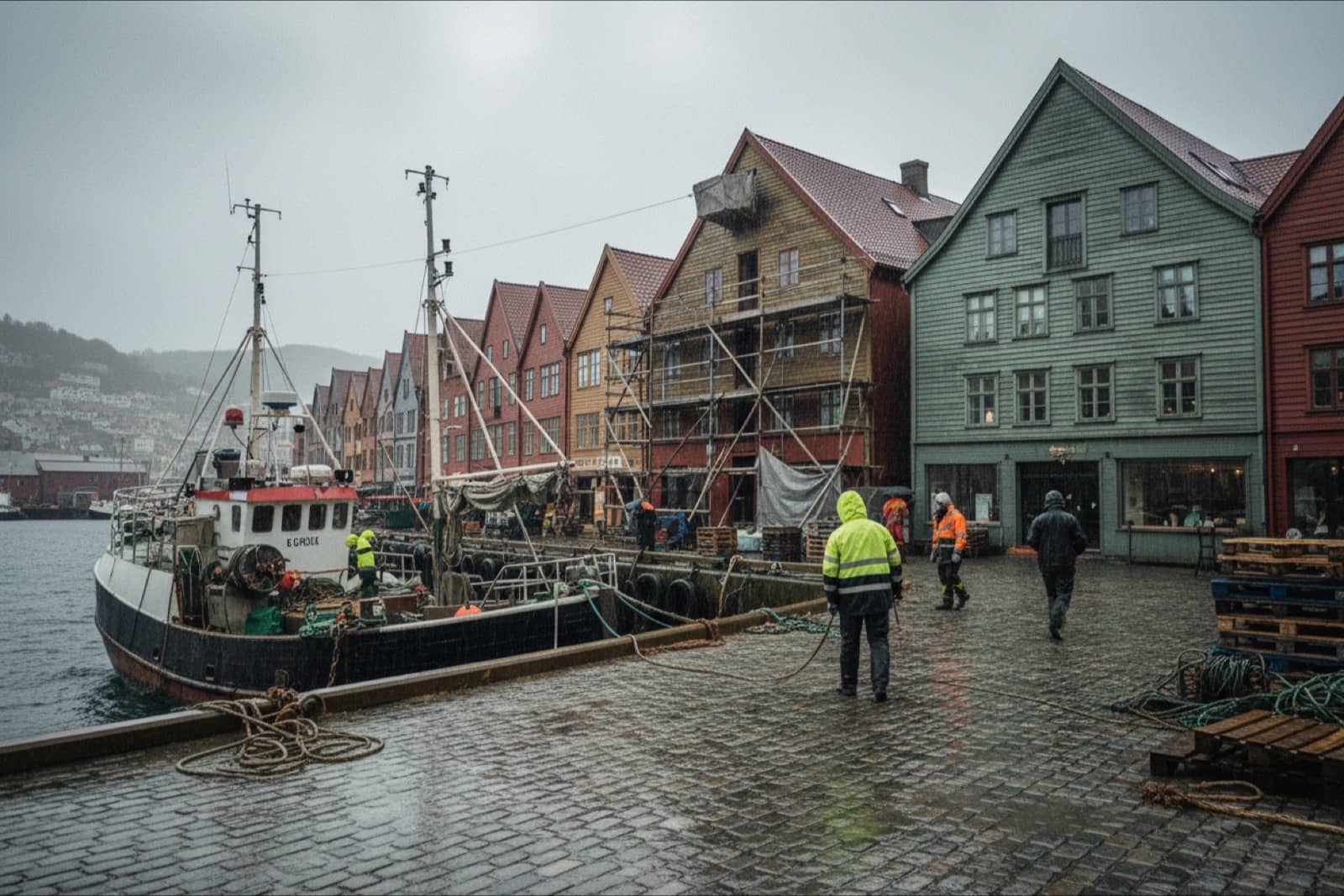
The rain is the thing you adjust to first. Bergen is one of the wettest cities in Europe, and it is not cold rain, it is persistent rain. Locals do not treat it as bad weather. They are just dressed for it.
The city grew around its harbour. The wooden row at Bryggen has stood there since the Hanseatic merchants ran the northern fish trade out of it. It is on the UNESCO list now, and people still walk through it on their way to work.
Seven mountains ring the city and a funicular runs up one of them. The hiking starts at a tram stop, which is what most people here do with a day off.
North and east of town the fjords start, Sognefjord and Hardanger among them. They are a bus or a ferry away, so they end up being weekends rather than postcards.
About 280,000 people live here, but it behaves like a big town. You run into the same faces.
Bergen in short
- Norway's second largest city
- The main port on the west coast
- Bryggen is a UNESCO world heritage site
- Flesland airport, reachable from the centre on the Bybanen
- Bybanen light rail runs across the city
Settling in
The employer usually arranges accommodation, and it is normally a room in shared housing. Budget €455-€500 a month; it is generally deducted from your pay.
In your first week you need a D-number and a tax card. Without the tax card the first payslip is taxed at 50 percent, and you get the difference back later, so it is worth doing straight away.
The Bybanen and the buses cover the city, and a monthly pass costs less than running a car and paying to park it. Work outside the city usually means employer transport.
Food costs more than you are used to. €300-€500 a month works if you cook. Kiosks and cafes eat a wage quickly.
A proper waterproof shell with layers under it matters more than a heavy winter coat. Buy it locally, where the choice is better and people know what holds up here.
What a month costs
€455-€500
Housing
A room in shared housing, usually deducted from your pay.€300-€500
Food
If you cook and shop in the ordinary supermarkets.€50-€60
Transport
A monthly pass for city transport.€805-€1060
Together
Before travel home and before going out.
The housing figure comes from our partners' own sites and is €455-€500 a month. If anyone offers you free accommodation, ask exactly what is included.
Questions about working in Bergen
How much will I earn in a month?
I do not know until I know the hours. The rate is 270–300 NOK/h for an experienced tradesman and the legal minimum is 239.61 NOK/h. The month is the hours you work times that rate, and the project sets the hours.
What does it cost to live in Bergen?
With employer-arranged housing, budget around €805-€1060 a month: €455-€500 for the room, €300-€500 for food and €50-€60 for transport.
Do I need Norwegian?
Not to start. Sites and warehouses run in English. In hotels and restaurants the language matters more, and it lets you ask for a better rate.
Does it really rain that much?
Yes. Bergen is one of the wettest cities in Europe and it can rain for a week straight in autumn. Cold is not the problem, wet is, and a decent shell with layers under it solves most of it.
Is there work all year?
Construction and the port run all year. Hotels and restaurants have more work in summer than in winter.
What happens after you apply
A chat with TANA
Our own AI, TANA, may start the conversation. It asks about your trade and the work you are after.
We read it and get in touch
Our team goes through your application and the chat. If a job fits, we contact you personally. If we do not get in touch right away, you stay on file and we may write a month or two later.
We put you forward
Your profile goes to the Norwegian employer and we set up the call.
Contract and travel
Your contract is with the Norwegian employer. We meet you in Norway and take you to your place.
Every application gets an answer within a month.