
How Norway was built: the history of Norwegian construction from stave churches to Rogfast
- stave churches left
- 28
- homes built in 1973
- 44,714
- homes today
- 2.76 M
- Legal minimum
- 239.61 NOK/h
- Typical rate
- 270–300 NOK/h
- Schedule
- Long-term, all year
- Who can apply
- EU and EEA citizens
Arbeidstilsynet, verified · 2026-08-08
≈ €25–€27 · with our partner employers
37.5 h week · overtime at least +40 %
no visa or work permit needed
In short
Norway built in timber for eight centuries, and 28 stave churches from 1150-1350 still stand. Fires and railways brought brick and blasting after 1904. The post-war state financed more than half of all new homes, output peaked at 44,714 dwellings in 1973, oil money paid for concrete platforms and 1,208 road tunnels, and today 2,762,504 homes stand, most of them built between 1946 and 1990 and now due for renovation.
The short version
Nine centuries of Norwegian construction, in eleven dates
1150-1350
Stave churches
Carpenters raise up to 2,000 timber churches on corner posts and sills. 28 survive.1350-1754
Bryggen, the Hanseatic wharf
Bergen's wooden trading houses burn and are rebuilt on the same plots for four centuries. UNESCO listed them in 1979.1904
Ålesund burns, and comes back in stone
About 850 houses gone in one winter night; 306 masonry buildings stand by 1907.1909
The Bergen railway opens
470 km and 200 tunnels across the mountains, built by up to 2,000 navvies.1944
Finnmark is burned
Around 11,000 houses destroyed and some 50,000 people evacuated in the retreat.1946
Husbanken is founded
The state housing bank goes on to finance more than half of every home built in the post-war decades.1951
Lambertseter, the first drabantby
Oslo's first satellite town, most of it built by 1958, sets the pattern for prefabricated blocks.1973
The peak year
44,714 dwellings completed in twelve months, a number Norway has not come near since.1995
Troll A is towed into place
A 472 m concrete platform weighing 1,200 thousand tonnes: the tallest structure ever moved.2000
The Lærdal tunnel opens
24.5 km through rock, still the longest road tunnel in the world.2019
Mjøstårnet, timber goes tall again
85.4 m and 18 floors in glulam and cross-laminated timber.
1150-1850
Why did Norway build in wood?
Two techniques carried the country. Laft, horizontal logs notched at the corners, built farms, storehouses and whole town quarters. The stave technique, corner posts on a sill frame with vertical planks between them, built the churches. Up to 2,000 stave churches once stood in Norway, most of them raised between 1150 and 1350; 28 are still standing, and Urnes, from the first half of the 12th century, is on the UNESCO list.
The colour came later and had nothing to do with taste at first. Red iron-oxide paint, cooked with rye flour and water, was the cheap coat, made industrially in Falun from 1764; white lead paint was expensive, so a farm often had a white front and red outbuildings. That is why so much of the countryside is still red and so many town fronts are white.
Bergen shows what wooden towns cost. The Hanseatic Kontor at Bryggen ran from about 1350 to 1754, burned in 1702 and again in 1955, and was rebuilt each time on the same medieval plots. It became Norway's first UNESCO World Heritage site in 1979.
What that timber tradition means for carpenters working here today
1850-1940
Brick, dynamite and the first national building programme
On the night of 23 January 1904 a storm drove a fire through Ålesund. About 850 houses burned and more than 10,000 people lost their homes. The town was rebuilt in brick and stone in the Art Nouveau style of the day, and by 1907 306 masonry buildings were finished. Fire rules after that pushed masonry into every Norwegian town centre.
The Bergen railway was decided in 1894 and opened on 27 November 1909: 470 km with 200 tunnels, built by up to 2,000 rallare, the navvies who moved from one construction camp to the next. It cost 52.5 million kroner, about a whole state budget of the time. Norway had learned to drill, blast and organise labour at scale, and it has been doing it ever since.
1944-1960
Rebuilding a country after 1944
A dedicated office, Finnmarkskontoret, with more than 800 staff, ran the reconstruction: standard house types, standard sizes, and materials shipped north. The gjenreisningshus, the reconstruction house, is still the most common building in many northern towns, and it is the housing stock that is being renovated up there today.
In the south the state built differently: with money. Husbanken, the state housing bank, was founded on 1 March 1946 and went on to finance more than half of all dwellings built in Norway in the post-war period. Even after 2005 it still financed 15 to 20 per cent of new homes each year.
The housing co-operatives supplied the other half of the machine. OBOS was founded in 1929, and from 1951 it built Lambertseter, Norway's first drabantby, most of it finished by 1958. Prefabricated concrete, standard flats, a school and a shopping centre: the model was copied around every Norwegian city for the next thirty years.
1960-1990
When were most Norwegian homes built?
The chart below is the whole post-war story in eight bars. Building rose through the 1950s and 1960s, peaked in the 1970s, held up through the 1980s, then collapsed after the banking crisis: the low point was 15,897 homes in 1993. The recovery took twenty years. Between 2016 and 2020 completions averaged 30,700 a year, the highest five-year level in three decades.
The last few years have turned down again: Norway finished 24,032 homes in 2024 and 19,498 in 2025, back to mid-1990s levels. That is the cycle the current shortage sits inside, and it is why experience and references count more now than they did in 2021.
SSB table 06512, completed dwellings 1951-2025. The 2020s bar covers 2020-2025.
1970-2000
Concrete, oil and the largest thing ever moved
Troll A is the extreme case: 472 metres from the seabed to the deck, 369 metres of it concrete, roughly 1,200 thousand tonnes, towed into position over a week in May 1995. It remains the tallest structure ever moved by people.
The money mattered as much as the concrete. Oil revenue is what let a country of five million fund the roads, tunnels, hospitals and schools that came next, and it is the reason the state can still commit to twelve-year infrastructure plans while the private housing market goes up and down.
2000-2036
The tunnel country
The Lærdal tunnel is 24.5 kilometres long, with three lit caverns along the way to keep drivers awake. It exists because a fjord crossing had to work in winter, which is the reason for most Norwegian tunnels: geography, not prestige.
The programme has not stopped. E39 Rogfast, 33.4 billion kroner, about 27 kilometres long and 400 metres below the sea, is due to open in 2033 as the world's longest and deepest undersea road tunnel. Tunnel work is the most weather-proof job on this list: rock does not care that it is February.
What Norway is building through 2036, and who it is short of
2019
What is the tallest wooden building in the world?
It matters beyond the record. Cross-laminated timber turned wood back into a structural material for buildings above four storeys, which is why carpenters on Norwegian sites now raise apartment blocks, schools and hospital wings in timber rather than only houses. The country that built stave churches spent a century in concrete and came back to wood with a crane.
The stock today
What Norway's 2.76 million homes are made of
| Type | Share |
|---|---|
| Detached house | 47.3 % |
| Block of flats | 26.3 % |
| Row house and other small houses | 12.1 % |
| Two-family house | 8.9 % |
| Other building types | 5.6 % |
| Built | Share |
|---|---|
| 1900 or earlier | 6.3 % |
| 1901-1940 | 8.8 % |
| 1946-1970 | 22.3 % |
| 1971-1990 | 25.2 % |
| 1991-2010 | 18.2 % |
| 2011 or later | 15.5 % |
| Unknown | 3.1 % |
Renovation
How big is renovation in Norway?
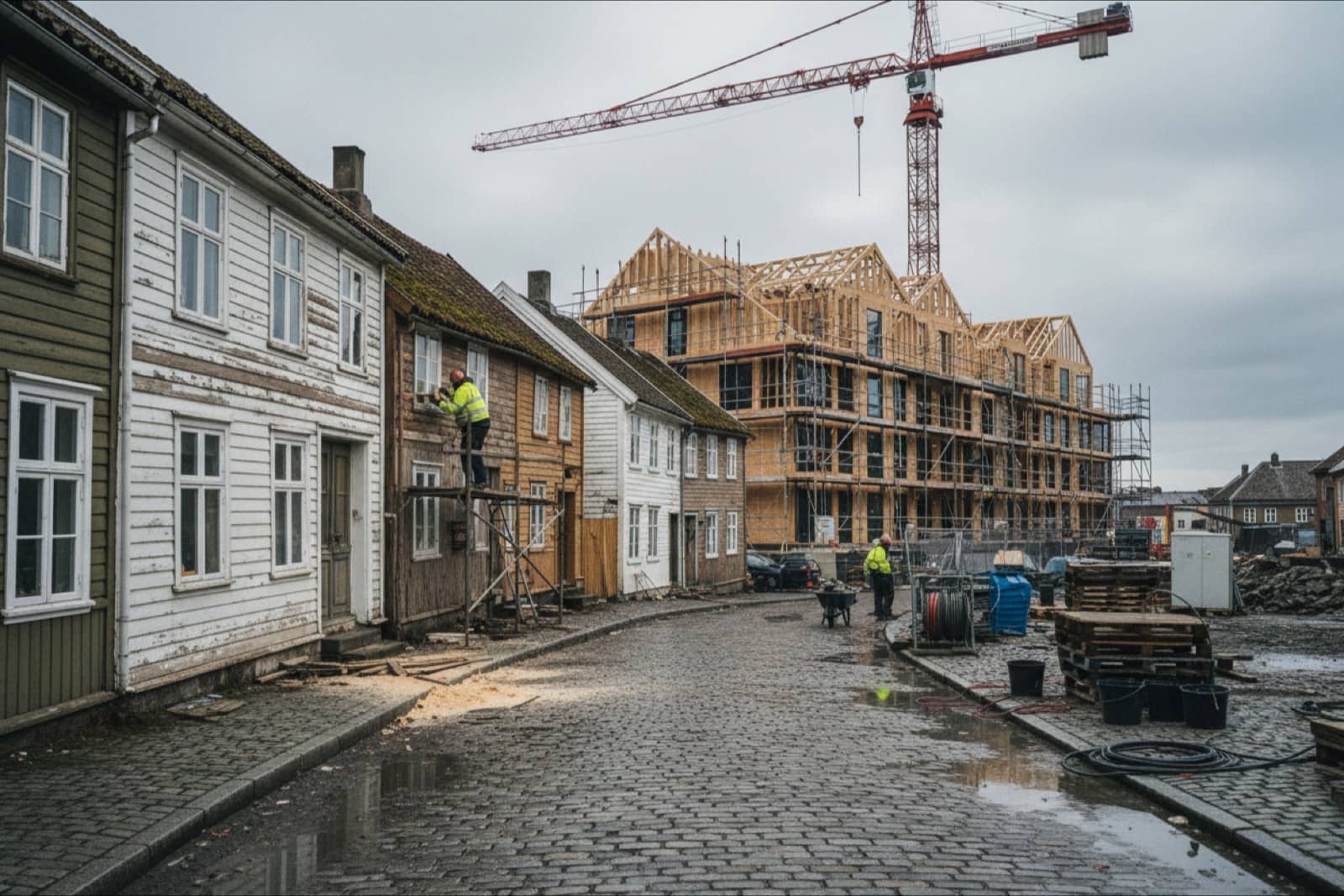
The arithmetic is simple. A house built in 1965 is sixty years old: the roof, the windows, the wiring and the bathroom have all reached the end of their lives at roughly the same time, and there are hundreds of thousands of them. Add the energy rules and the work is not optional.
Renovation in Norway is measured against TEK17, the building regulation in force since 2017. It sets what has to be met when you rebuild, not only when you build new, which is why a bathroom refit turns into membrane work, ventilation and documentation.
At the heritage end the same logic produced the stave-church programme: between 2001 and 2015 all 28 remaining stave churches were repaired for about 130 million kroner. A country that keeps its 800-year-old buildings standing is a country that keeps craftsmen busy.
Now
Who builds Norway today
Norwegian construction employed 251,000 people in 2022, up from 167,500 in 2006, and the share born in Norway has fallen from 88 per cent in 2008 to 77 per cent in 2022 (Fafo). Polish, Lithuanian, Latvian and German crews are not a footnote to this history; for the last two decades they are part of it.
Why Norway is short of builders, and what it is building next
Questions
The history of Norwegian construction: common questions
Why are Norwegian houses made of wood?
Because timber was the material at hand and it suits the climate: spruce and pine grew next to the site, could be worked with hand tools, and a log or timber-framed wall insulates as well as carries. Norway kept building in wood for eight centuries, and cross-laminated timber has brought it back for tall buildings too.
Why are Norwegian houses red?
Red iron-oxide paint was the cheap one. Cooked with rye flour and water, it was produced industrially in Falun from 1764 and used on outbuildings and modest houses, while white lead paint was the expensive coat for the front of a prosperous farm or a town house. The colour scheme you see today is an old price difference.
How many stave churches are left in Norway?
28, out of somewhere between 1,000 and 2,000 built in the Middle Ages. Most were raised between 1150 and 1350. Urnes, from the first half of the 12th century, is the oldest and is on the UNESCO World Heritage list. All 28 were restored between 2001 and 2015.
When was the Bergen railway built?
It was decided by parliament in 1894 and opened on 27 November 1909: 470 kilometres with 200 tunnels, built by up to 2,000 navvies and costing 52.5 million kroner, roughly a state budget of the day.
What happened to Finnmark in 1944?
The retreating German army burned it. About 11,000 houses in Finnmark and North Troms were destroyed and some 50,000 people were forcibly evacuated. Reconstruction was run by a dedicated office with more than 800 staff, using standard house types that still shape northern towns.
When were most homes in Norway built?
Between 1946 and 1990. Those four decades account for 47.5 per cent of the 2,762,504 dwellings standing today (SSB). The single busiest year was 1973 with 44,714 completions; the quietest recent year was 1993 with 15,897.
What is the tallest wooden building in the world?
Mjøstårnet in Brumunddal, Norway, held the title from 2019 until 2022, when Ascent in Milwaukee passed it. It is 85.4 metres tall with 18 floors, built in glued laminated timber and cross-laminated panels.
What is the longest road tunnel in the world?
The Lærdal tunnel in Norway, 24.5 kilometres, opened in 2000. Norway has about 1,208 road tunnels in total, and E39 Rogfast, due in 2033, will be both longer and deeper.
How many homes are there in Norway?
2,762,504 dwellings in 2026 (SSB). Detached houses are 47.3 per cent of them and flats in blocks 26.3 per cent, which is why carpentry rather than concrete is still the biggest site trade in the country.
Is renovation bigger than new construction in Norway?
Yes, measured by production value. The ROT market was 121.4 billion kroner in 2024 against a housing market that has been falling, and it is forecast to grow 2 to 3 per cent a year to 127 billion by 2027 (Prognosesenteret).
What is TEK17?
The Norwegian building regulation in force since 2017, replacing TEK10. It sets the minimum technical requirements for buildings, and it applies to renovation as well as new build, which is why refurbishment work in Norway carries more documentation than most people expect.
Sources
Where every number on this page comes from
- SSB, table 06512: completed dwellings 1946-2025updated 29 January 2026
- SSB, table 06266: dwellings by building type and year of constructionupdated 3 March 2026
- Samfunnsøkonomisk analyse, Boligbyggingen fra 2000-2020 i et historisk perspektivnote 2/2021
- Store norske leksikon, Ålesundsbrannenread 30 August 2026
- Store norske leksikon, Bergensbanenread 30 August 2026
- Norgeshistorie (University of Oslo), the reconstruction of Finnmark and North Tromsread 30 August 2026
- Husbanken, history of the state housing bankread 30 August 2026
- Store norske leksikon, Lambertseterread 30 August 2026
- Troll A platform, technical dataread 30 August 2026
- Statens vegvesen, E16 Lærdal tunnelread 30 August 2026
- Mjøstårnet, technical dataread 30 August 2026
- Riksantikvaren stave church programme, reported by NRK2015
- Direktoratet for byggkvalitet, TEK17 entry into force1 July 2017
- Prognosesenteret ROT-market figures, via Nemitek23 September 2025
- Store norske leksikon, falurødtread 30 August 2026
What happens after you apply
A chat with TANA
Our own AI, TANA, may start the conversation. It asks about your trade and the work you are after.
We read it and get in touch
Our team goes through your application and the chat. If a job fits, we contact you personally. If we do not get in touch right away, you stay on file and we may write a month or two later.
We put you forward
Your profile goes to the Norwegian employer and we set up the call.
Contract and travel
Your contract is with the Norwegian employer. We meet you in Norway and take you to your place.
Every application gets an answer within a month.
Apply
The next chapter needs carpenters, concrete crews and electricians
If you build for a living and hold an EU or EEA passport, send one application. I check your experience against the roles our partner employers are filling now and reply personally.
Keep reading
- Why Norway needs construction workersThe shortage, the pipeline and the sources behind both
- Construction jobs in NorwayAll 25 trades, statutory rates and open vacancies
- Carpenter jobs in NorwayThe trade this whole history runs on
- Offshore jobs in NorwayWhat the oil era turned into
- Salaries in NorwayWhat the trades earn today
- Open vacanciesWhat is being filled this week