Crane operator jobs in Norway: G-class papers, rates, reality
- Legal minimum
- 239.61 NOK/h
- Typical rate
- 270–300 NOK/h
- Schedule
- Long-term, all year
- Who can apply
- EU and EEA citizens
Arbeidstilsynet, verified · 2026-08-08
≈ €25–€27 · with our partner employers
37.5 h week · overtime at least +40 %
no visa or work permit needed
How much does a crane operator earn in Norway?
| Rate | NOK/h | ~EUR/h |
|---|---|---|
| Statutory minimum, skilled worker (fagarbeider) | 264.32 | ~€24 |
| Statutory minimum, at least 1 year in the trade | 249.00 | ~€23 |
| Statutory minimum, no construction experience | 239.61 | ~€22 |
| Statutory minimum, under 18 | 162.44 | ~€15 |
| Typical rate with our partners, experienced crane operator | 270–300 | ~€25–€27 |
Statutory rates in force since 15 June 2025. Verified: Arbeidstilsynet · 2026-08-08
A tower crane runs as long as the site does, so operators collect the site's overtime: at least 40% extra by law, commonly 50% under collective agreements.
G-class certificates: which paper for which crane
What a crane operator needs on a Norwegian site
- HMS card (HMS-kort), everyone, always
- Mandatory for every person on a Norwegian construction site. Your employer orders it once you and the company are registered, and it stays valid for 2 years.Source: Arbeidstilsynet, HSE cards for construction sites · 2026-08-08
- G-class kompetansebevis, certified training (§10-3)
- Certified safety training for the crane class you operate: G1 mobile, G2 tower, G3 portal, G4 bridge and gantry, G8 loader crane, G11 rigging gear. The kompetansebevis documents the training and does not expire, but it works together with employer authorisation for the specific equipment, not instead of it.Source: Arbeidstilsynet, sertifiseringsordningen for arbeidsutstyr (forskrift om utførelse av arbeid § 10-3) · 2026-08-08
- Foreign crane licences: assessed, not stamped
- No authority pre-approves your foreign crane licence. Your employer is responsible for assessing whether your training and licence match the Norwegian requirement, and EEA qualifications can be topped up through a certified training provider where a gap remains. Bring licence, training records and logged hours, with English translations.Source: Arbeidstilsynet, sertifiseringsordningen for arbeidsutstyr (forskrift om utførelse av arbeid § 10-3) · 2026-08-08
What the job actually looks like
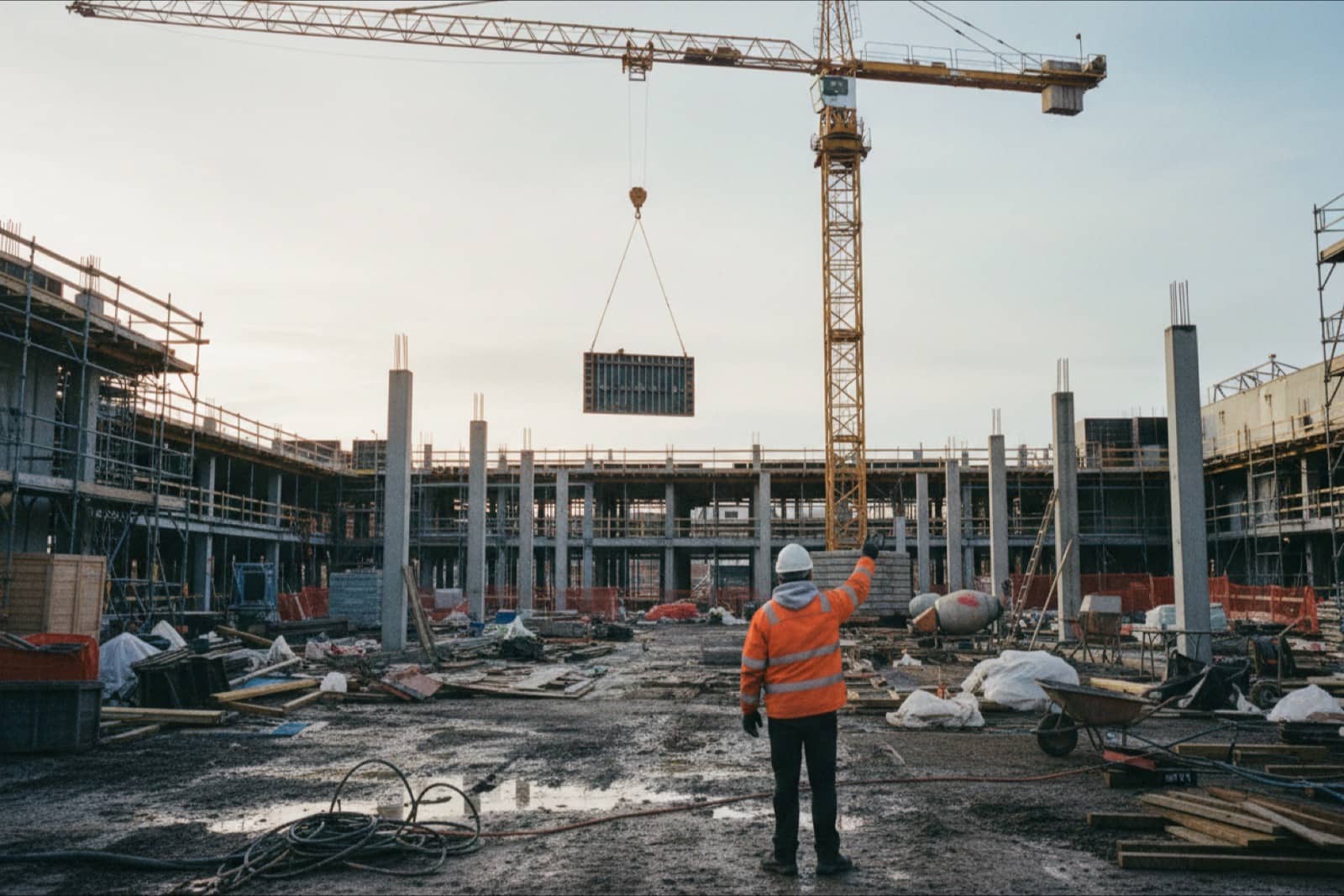
Tower crane work on Norwegian sites is the site's tempo from the cab: formwork panels, rebar bundles, timber packs and prefab elements, all day, coordinated by radio with riggers below. Mobile and loader crane work is assignment-driven: setting trusses one day, machinery the next.
Norwegian lift culture is strict and that works in your favour: lift plans exist, loads are rigged by people with G11 training, and refusing an unsafe lift is backed by law, not just by courage. Operators who communicate clearly in English and keep clean logs earn trust fast.
Your rights on a Norwegian construction site
- Construction minimum wages are legally binding for everyone on site: 239.61 NOK/h from day one, 249 NOK/h after a year in the trade, 264.32 NOK/h with a trade certificate. Find your tier and compare it with your payslip.
- Overtime: at least +40% by law. Collective agreements often pay more, so check what your contract says.
- Holiday pay is 10.2% of your year's wages. It is not a bonus, it is your money, paid out the following year.
- Rest: at least 11 hours off per day and 35 hours per week.
- Housing deductions from your wages are only legal when agreed in writing and kept within the limits the law sets.
- You have the right to a written contract in a language you understand, before you travel.
- You never pay to get a job. Charging a worker a recruitment fee is illegal.
- If something is wrong, Arbeidstilsynet, the Norwegian Labour Inspection Authority, takes reports in English and anonymously. In construction the Fellesforbundet union can help too.
Rates and rules verified at the source: Arbeidstilsynet · 2026-08-08
Reviews: what crane operators say about Norway
We don't publish made-up five-star testimonials, and you should treat anonymous "worker reviews" with care. Do this instead: look the employer up in the Norwegian registers, ask to talk to someone already on the crew, and compare the offer against the statutory rates on this page. As we collect real, signed accounts from people we've placed, we publish them, with their permission.
Crane operator jobs in Norway: FAQ
How much does a crane operator earn in Norway?
The statutory minimum on Norwegian sites is 264.32 NOK/h for a skilled worker (fagarbeider), 249 NOK/h after one year in the trade and 239.61 NOK/h as a starter. Experienced crane operators we place typically get 270–300 NOK/h, about €25–€27. Long site days add overtime at 40–50% on top.
How much does a construction worker earn in Norway?
Norwegian construction minimum wages are set by law: 239.61 NOK/h with no experience, 249 NOK/h after a year in the sector, 264.32 NOK/h with a trade certificate. At about 162.5 hours a month, the skilled floor alone is roughly 42,952 NOK gross a month before overtime.
What crane licence do I need in Norway?
Norway uses G-class competence certificates (kompetansebevis) earned through certified safety training under forskrift om utførelse av arbeid §10-3: G1 mobile cranes, G2 tower cranes, G3 portal cranes, G4 bridge and gantry cranes, G8 loader cranes, and G11 for rigging gear. The class must match the crane you operate.
Does a Norwegian crane certificate expire?
No. A kompetansebevis documents completed certified safety training and does not expire. It's not a standalone right to operate though: your employer authorises you for the specific equipment on their site, and that authorisation is what inspectors check alongside the certificate.
Is my foreign crane licence valid in Norway?
It's assessed, not automatically accepted. Your employer is responsible for judging whether your foreign training and licence match the Norwegian requirement for the crane class you'll run, and EEA qualifications can be built on through a certified training provider if a gap remains. Bring every document you have: licence, training records, logbook hours, all with English translations.
Can a US citizen get a job in Norway?
Honestly: not through us, and not easily. A US citizen needs a Norwegian employer to sponsor a residence permit for work through UDI before starting, and those permits mostly go to roles that can't be filled from the EU/EEA labour market. We only place EU and EEA citizens, who need no permit at all.
Do I need visa sponsorship for construction jobs in Norway?
If you're an EU or EEA citizen: no. Norway is in the EEA, so you can take a crane job without a visa, work permit or sponsorship. You register with the police once if you stay past three months. Non-EEA citizens need an employer-sponsored permit, which we don't arrange.
Which jobs are in demand in Norway?
In construction: crane operators with G1 or G2 papers, carpenters, formwork carpenters, scaffolders and electricians come up most often in our employer conversations. Operators who also rig (G11) place fastest. Outside construction, fish processing and transport recruit year-round.
Tower crane or mobile crane: which pays better in Norway?
The statutory floor is the same; the difference is hours and responsibility. Tower crane operators on big sites work the site's full day and often its overtime. Mobile crane work varies with assignments. In both cases overtime pays at least 40% extra by law, commonly 50%, and that's what separates two months on the same base rate.
Is accommodation included with crane operator jobs?
Usually not, and you should get the housing terms in writing before you travel. The normal setup: the employer or we help you find a room, and you pay the rent yourself, typically 5,000-5,500 NOK a month. Norwegian law limits what can be deducted from wages for housing.
Do I need to speak Norwegian to operate a crane in Norway?
You need to communicate precisely with the crew, and on international sites that language is English: radio discipline matters more than vocabulary size. Basic solid English is enough for most placements; Norwegian is a plus for signaller-heavy jobs, not a requirement.
How much tax will I pay as a crane operator in Norway?
New foreign workers can use the PAYE scheme: a flat 25% deducted automatically, no tax return to file. On 270 NOK/h at full time, that leaves roughly 32,906 NOK net a month before overtime.
What happens after you apply
A chat with TANA
Our own AI, TANA, may start the conversation. It asks about your trade and the work you are after.
We read it and get in touch
Our team goes through your application and the chat. If a job fits, we contact you personally. If we do not get in touch right away, you stay on file and we may write a month or two later.
We put you forward
Your profile goes to the Norwegian employer and we set up the call.
Contract and travel
Your contract is with the Norwegian employer. We meet you in Norway and take you to your place.
Every application gets an answer within a month.
We're looking for crane operators for Norway
Send your CV with your crane classes, licence scans and logged hours. We'll check what your papers cover in Norway and come back with concrete terms.