Formwork carpenter jobs in Norway: rates, systems, no certificate needed
- Legal minimum
- 239.61 NOK/h
- Typical rate
- 270–300 NOK/h
- Schedule
- Long-term, all year
- Who can apply
- EU and EEA citizens
Arbeidstilsynet, verified · 2026-08-08
≈ €25–€27 · with our partner employers
37.5 h week · overtime at least +40 %
no visa or work permit needed
How much does a formwork carpenter earn in Norway?
| Rate | NOK/h | ~EUR/h |
|---|---|---|
| Statutory minimum, skilled worker (fagarbeider) | 264.32 | ~€24 |
| Statutory minimum, at least 1 year in the trade | 249.00 | ~€23 |
| Statutory minimum, no construction experience | 239.61 | ~€22 |
| Statutory minimum, under 18 | 162.44 | ~€15 |
| Typical rate with our partners, experienced formwork carpenter | 270–300 | ~€25–€27 |
Statutory rates in force since 15 June 2025. Verified: Arbeidstilsynet · 2026-08-08
Full time is about 162.5 hours a month, so the skilled minimum alone is roughly 42,952 NOK gross a month. Overtime pays at least 40% extra by law, and collective agreements commonly pay 50%. Formwork runs on pour deadlines, so overtime is a normal part of the pay.
Do you need a formwork certificate in Norway? No.
What you actually need on site
- HMS card (HMS-kort), everyone, always
- Mandatory for every person on a Norwegian construction site. Your employer orders it once you and the company are registered in the Norwegian registers, and it stays valid for 2 years. Without it you don't get past the gate.Source: Arbeidstilsynet, HSE cards for construction sites · 2026-08-08
- Formwork qualification: none exists
- No Norwegian regulation requires a formwork certificate. The scaffolding training tiers in chapter 17 of the work performance regulation apply to scaffolds, not to formwork. If a recruiter tells you to pay for a "formwork licence" before travelling to Norway, walk away.Source: Forskrift om utførelse av arbeid, kapittel 17 (§§ 17-2, 17-3, 17-4) · 2026-08-08
Peri, Doka, Meva: the experience employers actually screen for
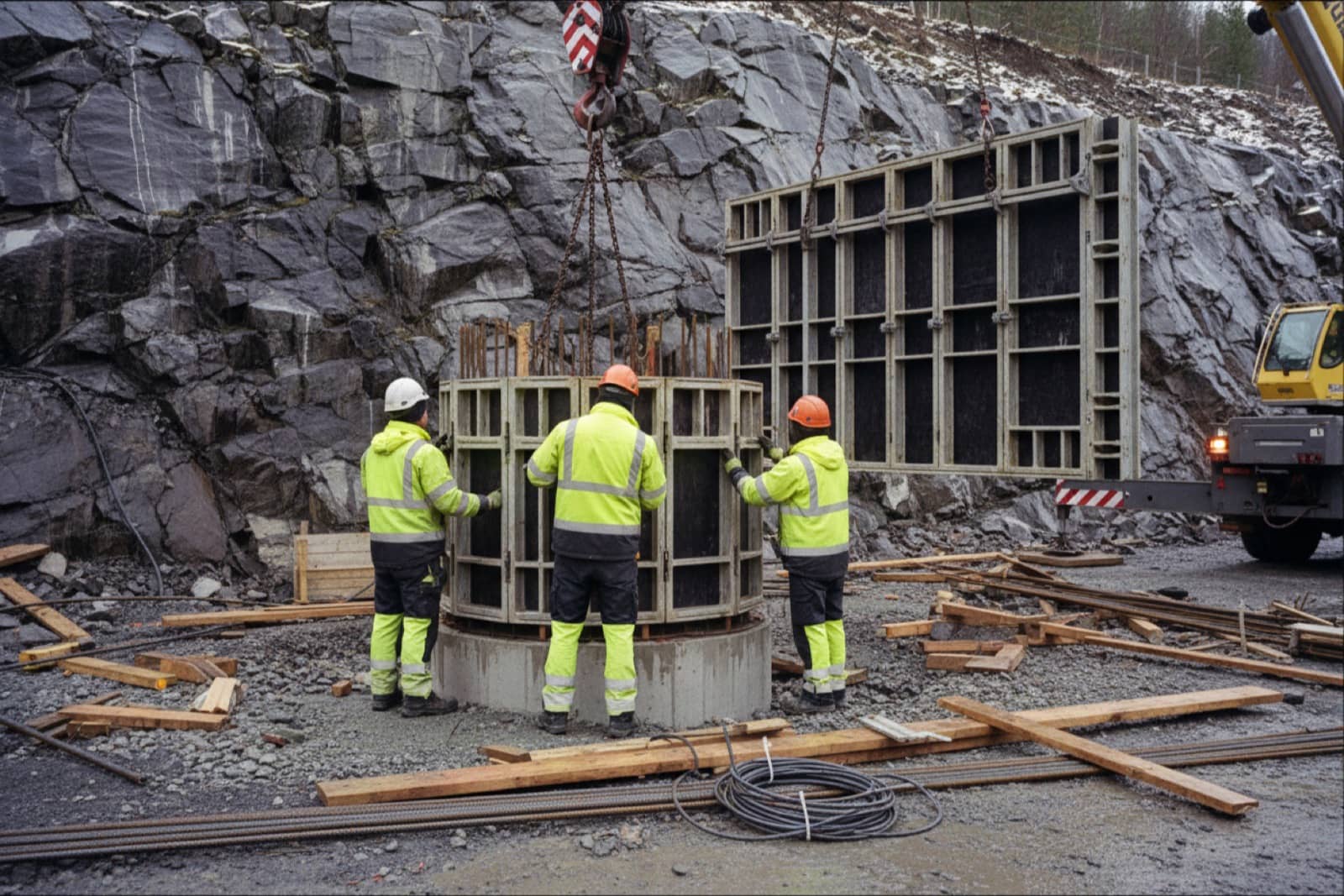
Norwegian sites run the big European panel systems: Peri, Doka and Meva for walls and columns, with matching slab tables and shoring. Since there's no certificate to filter candidates, the interview is about what you've built: which systems, what wall heights, how many pours a week, whether you can read formwork drawings and set out from them.
On high-rise jobs the core usually goes up with climbing formwork, jumped floor by floor. Crews with climbing-formwork experience are the hardest to find and the easiest to place. If you've worked self-climbing or crane-lifted climbing systems, say so in your application, with the project name.
Bring photos of your work and reference contacts if you have them. A foreman's phone number from a previous formwork job does more for your rate than any paper.
The skilled rate and your trade papers
The top statutory tier of 264.32 NOK/h is for skilled workers, in Norwegian fagarbeider. A foreign trade certificate in carpentry or concrete work counts when your employer recognises it as equivalent, so bring your certificate with an English translation. Without papers, you start at 239.61 NOK/h, move to 249 NOK/h after a year in the trade, and your negotiated rate can sit well above the floor at any point.
In practice, experienced formwork carpenters without a formal certificate still land in the 270–300 NOK/h band with our partners, because system experience is what the market pays for.
Who this job is not for
Honest list. Formwork is heavy: panels, props and beams all day, often in rain, wind or below zero. It's precise: a wall out of plumb is your name on it when the concrete sets. It runs on pour deadlines, so long days cluster. And it repeats: set, pour, strip, move, again.
If you want an indoor trade or a fixed 8-to-4 rhythm, look at our other construction pages instead. If you've done formwork before and want Norwegian rates for it, this is one of the best-paying site trades you can bring experience into.
Your rights on a Norwegian construction site
- Construction minimum wages are legally binding for everyone on site: 239.61 NOK/h from day one, 249 NOK/h after a year in the trade, 264.32 NOK/h with a trade certificate. Find your tier and compare it with your payslip.
- Overtime: at least +40% by law. Collective agreements often pay more, so check what your contract says.
- Holiday pay is 10.2% of your year's wages. It is not a bonus, it is your money, paid out the following year.
- Rest: at least 11 hours off per day and 35 hours per week.
- Housing deductions from your wages are only legal when agreed in writing and kept within the limits the law sets.
- You have the right to a written contract in a language you understand, before you travel.
- You never pay to get a job. Charging a worker a recruitment fee is illegal.
- If something is wrong, Arbeidstilsynet, the Norwegian Labour Inspection Authority, takes reports in English and anonymously. In construction the Fellesforbundet union can help too.
Rates and rules verified at the source: Arbeidstilsynet · 2026-08-08
Who actually builds in Norway
The names below are the large Norwegian contractors whose sites formwork crews end up on, directly or through subcontractors. This list exists so you can check who really builds where you are going.
- Veidekke
General contractor · Builds nationwide
- AF Gruppen
General contractor · Builds nationwide
- Skanska Norge
General contractor · Builds nationwide
- Peab Norge
General contractor · Builds nationwide
- Consto
General contractor · HQ in Tromsø
- HENT
General contractor · Builds nationwide
- Bravida Norge
Electrical and HVAC · Builds nationwide
- Caverion Norge
Electrical and HVAC · Builds nationwide
We don't claim to place workers with each of these companies. They are listed as verifiable market context, nothing more.
Reviews: how to check a formwork employer yourself
We don't publish made-up five-star testimonials, and you should treat any anonymous "worker reviews" with care. Do this instead: look the employer up in the Norwegian registers, ask to talk to someone already on the crew, and compare the offer against the statutory rates on this page. As we collect real, signed accounts from people we've placed, we publish them, with their permission.
Formwork carpenter jobs in Norway: FAQ
What is the hourly rate for a formwork carpenter in Norway?
The statutory minimum on Norwegian construction sites is 264.32 NOK/h for a skilled worker (fagarbeider), 249 NOK/h after one year in the trade and 239.61 NOK/h as a starter. Experienced formwork carpenters we place typically get 270–300 NOK/h, which is about €25–€27. These floors are law, not an employer's goodwill, and they apply to every worker in Norway regardless of nationality.
How much does a construction worker earn in Norway?
Norwegian construction has legally binding minimum wages: 239.61 NOK/h with no experience, 249 NOK/h after one year in the sector and 264.32 NOK/h with a trade certificate. At full time (about 162.5 hours a month) the skilled minimum works out around 42,952 NOK gross a month before overtime.
Do I need a certificate to work as a formwork carpenter in Norway?
No. Formwork has no separate licence or certificate requirement in Norway. You need the HMS card every construction worker carries, and your employer must document any equipment training you get, but there is no formwork qualification to pass before you start. What employers screen for instead is real system experience: Peri, Doka or Meva, and the ability to read formwork drawings.
Which formwork systems do Norwegian sites use?
Mostly the big European panel systems: Peri, Doka and Meva for walls and columns, with matching slab and shoring systems. High-rise cores are typically poured with climbing formwork. If you can set, plumb, brace and strip one of these systems cleanly, you will recognise almost everything on a Norwegian site.
Can a US citizen get a job in Norway?
Honestly: not through us, and not easily at all. US citizens need a Norwegian employer to sponsor a residence permit for work through UDI before starting, and those permits mainly go to roles the employer can't fill from the EU/EEA labour market. We only place EU and EEA citizens, who can work in Norway without any permit.
Do I need visa sponsorship for construction jobs in Norway?
If you're an EU or EEA citizen: no. Norway is in the EEA, so you can take a construction job there without a visa, work permit or sponsorship of any kind. You register with the police once if you stay past three months. Non-EEA citizens do need an employer-sponsored permit, which we don't arrange.
Which jobs are in demand in Norway?
In construction: formwork carpenters, concrete workers, scaffolders, carpenters and electricians come up again and again in our employer conversations. Skilled trades with documented experience are the easiest to place. Outside construction, Norway steadily recruits for fish processing, transport and healthcare.
Is accommodation included with formwork jobs in Norway?
Usually not included, and you should get the housing terms in writing before you travel. The normal setup: the employer or we help you find a room, and you pay the rent yourself, typically 5,000-5,500 NOK a month for a room in worker housing. Norwegian law limits what can be deducted from wages for housing.
Do I need to speak Norwegian on formwork sites?
No. Basic English is enough to work in a formwork crew, and most sites with foreign workers run in English. You also have the right to an employment contract in a language you understand, before you leave home.
How is overtime paid on Norwegian sites?
Overtime pays at least 40% extra by law. Collective agreements commonly pay 50%. Formwork runs on pour deadlines, so overtime weeks happen, and they are where monthly pay climbs well past the base rate.
How much tax will I pay as a foreign worker?
New foreign workers can use the PAYE scheme: a flat 25% deducted automatically, no tax return to file. On the skilled minimum of 264.32 NOK/h at full time, that leaves roughly 32,214 NOK net a month before overtime.
What tools does a formwork carpenter bring?
The formwork systems, panels, props and consumables belong to the company. Most formwork carpenters bring their own tool belt basics: hammer, level, tape. Requirements differ between companies, so ask before you travel and get the list in your contract.
Are shuttering carpenter jobs in Norway the same as formwork jobs?
Yes. Shuttering carpenter is the British name for the same trade Norway calls forskalingssnekker: building and striking the moulds that concrete is poured into. The pay rules are the same too, 239.61 NOK/h statutory floor for a new entrant and 264.32 NOK/h with a recognised trade certificate, with experienced crews on Doka, PERI or MEVA systems typically at 270–300 NOK/h.
What happens after you apply
A chat with TANA
Our own AI, TANA, may start the conversation. It asks about your trade and the work you are after.
We read it and get in touch
Our team goes through your application and the chat. If a job fits, we contact you personally. If we do not get in touch right away, you stay on file and we may write a month or two later.
We put you forward
Your profile goes to the Norwegian employer and we set up the call.
Contract and travel
Your contract is with the Norwegian employer. We meet you in Norway and take you to your place.
Every application gets an answer within a month.
We're looking for formwork carpenters for Norway
Send your CV with the systems you've worked (Peri, Doka, Meva) and photos of your work if you have them. We'll check your experience and come back with concrete terms.