
Jobs in Northern Norway
- NOK per hour
- 229–300
- Where
- Tromsø, Finnsnes
- Work
- All year
- Legal minimum
- 239.61 NOK/h
- Typical rate
- 270–300 NOK/h
- Schedule
- Long-term, all year
- Who can apply
- EU and EEA citizens
Arbeidstilsynet, verified · 2026-08-08
≈ €25–€27 · with our partner employers
37.5 h week · overtime at least +40 %
no visa or work permit needed
What the work pays
The bottom rate is set by law. In construction it is 239.61 NOK/h, 249.00 NOK/h after a year in the trade, and 264.32 NOK/h with a trade certificate. In fish processing the partner base rate is 228.65 NOK/h, rising to 240.96 NOK/h with experience.
Experienced trades working with our partners are on 270–300 NOK/h, which is about €25–€27 an hour.
I will not quote you a month. Pay is the rate times the hours you work, and the project sets the hours: one month runs long, the next one is winding down. Overtime is at least +40 % by law and holiday pay of 10.20 % comes on top. If you want your own number, put your own hours in.
The work I place people into
What the far north asks of you
Two kinds of people come north: the ones who want to earn, and the ones who want to see what life is like at the Arctic Circle. It works best when both reasons apply.
The towns are small. Tromsø is the biggest and you can still walk to everything you need. Finnsnes is smaller again. If you want city nights out, they are not here.
What you get instead is work all year and a shorter queue for every opening than you would face around Oslo. Plenty of people come for one season and stay for several years.
Do not come if
- you need a city and somewhere to go in the evening
- eight hours of wind and wet is more than you want
- you need to be home every weekend
- you cannot manage without company that speaks your language
Building in the cold
The trade is the same. The weather just decides more of it. Frozen ground means digging and foundations take longer, and need kit that thaws the ground first.
Winter concrete gets blankets, heaters and admixtures, then it gets protected until it has gained strength. Nobody rushes that, because rushing it means pouring twice.
Wind off the sea stops the crane and closes the scaffold. That is not a slow day, it is the safety limit, and everyone on site knows where it sits.
For most of a winter shift you work under site lighting. You get used to it, but it catches people out in their first winter.
Materials arrive on the schedule the road and the ferry allow, not the one the yard would like. So you plan ahead, and there is always something on site to get on with while a load is coming.
What the employer issues and what you bring
- Workwear, winter outer layer and helmet - from the employer
- Insulated safety boots - from the employer
- Thermal base layers - yours, and bring several
- Gloves - yours, and they wear out fast
- Head torch - yours
The polar night and the midnight sun
In Tromsø the sun stays below the horizon for roughly two months in midwinter. That is the polar night, and it is not black: at noon the sky is blue, the snow throws that light back, and you can read outdoors.
Sleep is the hard part. People who live here get up at the same time every day, go outside at midday while there is light, and use a daylight lamp and vitamin D. Sleep until dark on your days off and January gets very long.
The northern lights are ordinary here in those months. On a clear evening you see them from the edge of town, and after a few times you stop photographing them.
From May the sun does not set at all. Then the problem reverses: you need curtains that actually block light, and the discipline to stop work when the clock says so rather than when it gets dark.
Where you would be based
Tromsø
The largest town in Northern Norway and a university town. The airport, the hospital, the shops and most of the sites our partners run are here.Finnsnes
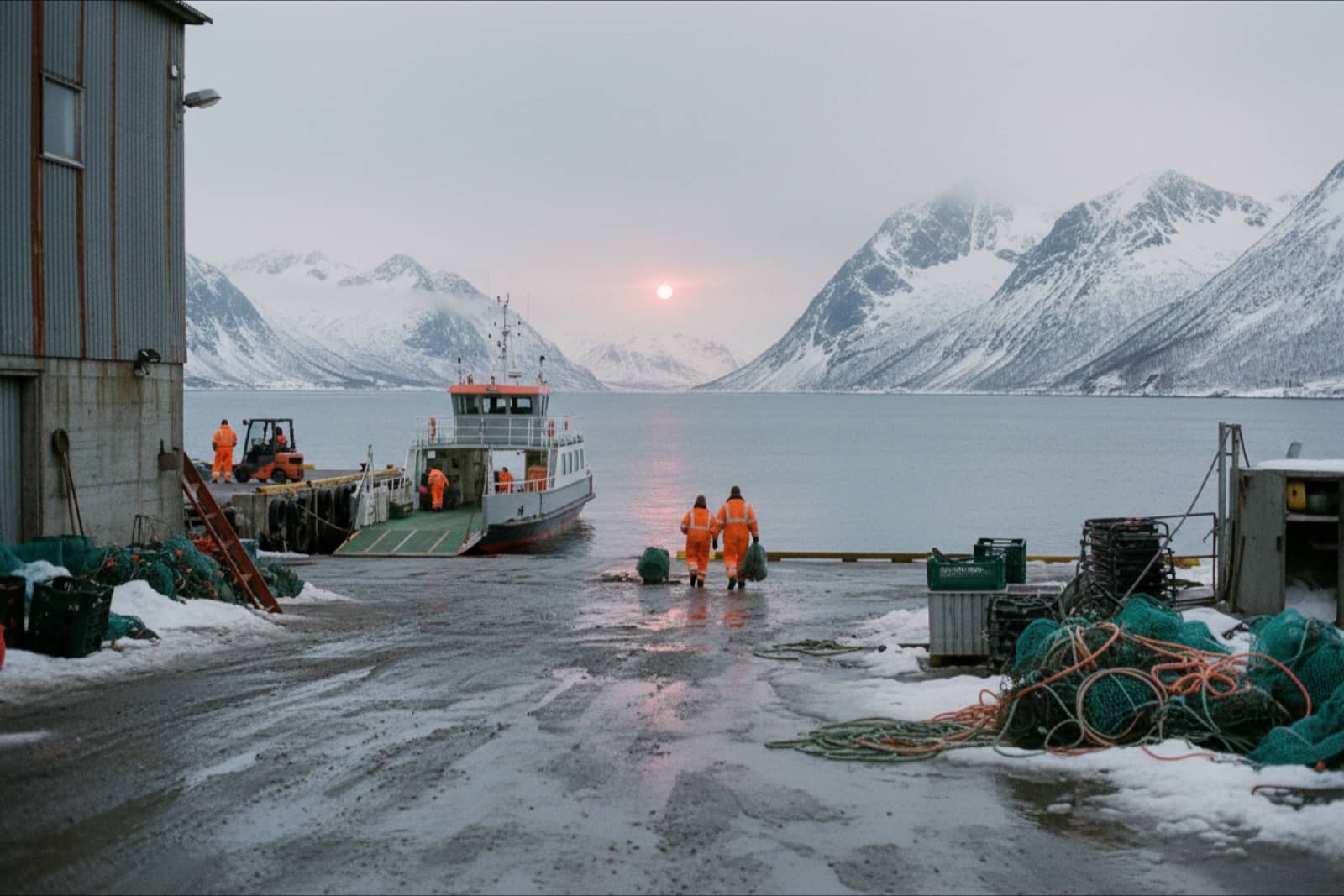
A small town on the way to Senja. Fish processing, the harbour and construction; Tromsø is a couple of hours away by bus.
Questions about working up north
How much will I earn in a month?
The honest answer is that I do not know until I know the hours. The rate is 270–300 NOK/h for an experienced tradesman and starts at 228.65 NOK/h in a fish plant. The month is the hours you work times that rate, and the project sets the hours.
Is it very cold in winter?
Cold is not the main problem. The coast is milder than people expect because the sea keeps it that way. Wind and wet are the hard part, and layers beat one thick coat every time.
How long is the polar night?
In Tromsø the sun stays below the horizon for about two months around midwinter. There is still light, it is just blue and low. Site work carries on under floodlights.
Do I need Norwegian?
Not to start. Sites and plants run in English, and most crews already have people from Latvia and Poland on them. Norwegian raises your rate later and makes life outside work easier.
Is there work all year?
Yes. Construction and fish processing both run through the year up here, which is why the contracts are long-term rather than single-season.
What should I bring the first time?
Your passport or ID card, any trade papers you hold, and thermal base layers. Workwear and a helmet come from the employer. The rest you can buy when you get there.
What happens after you apply
A chat with TANA
Our own AI, TANA, may start the conversation. It asks about your trade and the work you are after.
We read it and get in touch
Our team goes through your application and the chat. If a job fits, we contact you personally. If we do not get in touch right away, you stay on file and we may write a month or two later.
We put you forward
Your profile goes to the Norwegian employer and we set up the call.
Contract and travel
Your contract is with the Norwegian employer. We meet you in Norway and take you to your place.
Every application gets an answer within a month.