Facade jobs in Norway: rainscreen cladding, rates and rules
- Legal minimum
- 239.61 NOK/h
- Typical rate
- 270–300 NOK/h
- Schedule
- Long-term, all year
- Who can apply
- EU and EEA citizens
Arbeidstilsynet, verified · 2026-08-08
≈ €25–€27 · with our partner employers
37.5 h week · overtime at least +40 %
no visa or work permit needed
How much does a facade installer earn in Norway?
| Rate | NOK/h | ~EUR/h |
|---|---|---|
| Statutory minimum, skilled worker (fagarbeider) | 264.32 | ~€24 |
| Statutory minimum, at least 1 year in the trade | 249.00 | ~€23 |
| Statutory minimum, no construction experience | 239.61 | ~€22 |
| Statutory minimum, under 18 | 162.44 | ~€15 |
| Typical rate with our partners, experienced facade installer | 270–300 | ~€25–€27 |
Statutory rates in force since 15 June 2025. Verified: Arbeidstilsynet · 2026-08-08
Rainscreen: the build-up behind almost every Norwegian facade
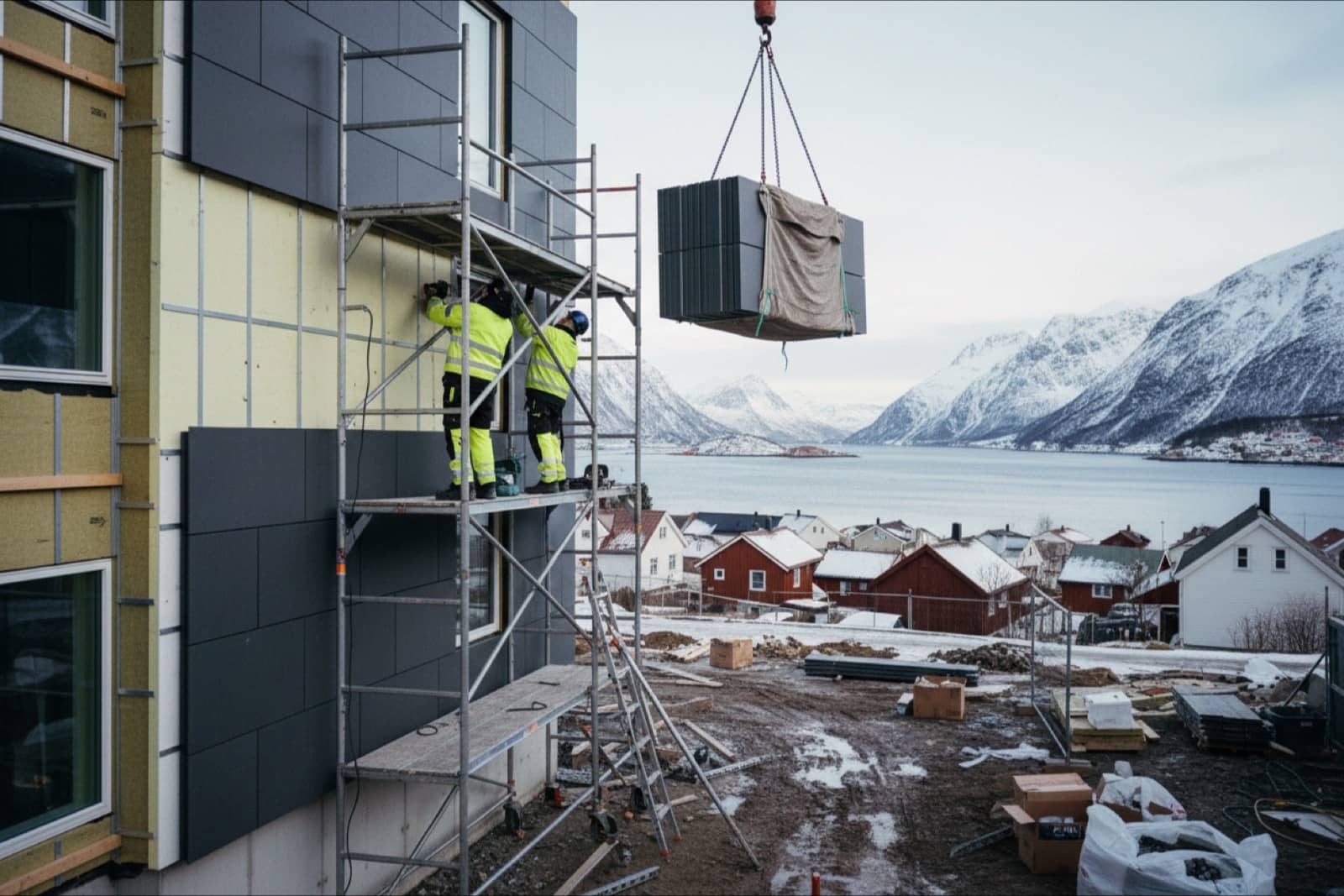
The Norwegian climate pushed the market to ventilated rainscreen long ago: a cladding skin on a sub-frame, an air gap that drains and dries, then wind barrier and insulation on the structure. Your job is the whole stack: setting out the sub-frame to line and level, insulation and barrier work, then the visible skin.
The skins vary by building: fibre-cement boards and metal cassettes on commercial projects, profiled sheet on industrial ones, timber cladding on housing, glazed and composite panels on offices. Precision on the sub-frame decides everything above it, which is why employers ask about setting-out experience first.
If you've mounted any rainscreen system, name it in your application, with the fixing method (visible, concealed, adhesive) and the biggest project you carried it on.
Work at height: what must be documented
What you need before the first shift
- HMS card (HMS-kort), everyone, always
- Mandatory for every person on a Norwegian construction site. Your employer orders it once you and the company are registered, and it stays valid for 2 years. Without it you don't get past the gate.Source: Arbeidstilsynet, HSE cards for construction sites · 2026-08-08
- Documented work-at-height training, chapter 17
- Chapter 17 of the work performance regulation (forskrift om utførelse av arbeid) requires documented training matched to the access equipment in use, including scaffold user training. Foreign certificates count as documentation, but your employer must check the scope matches, so bring them with an English translation.Source: Forskrift om utførelse av arbeid, kapittel 17 (§§ 17-2, 17-3, 17-4) · 2026-08-08
Your rights on a Norwegian construction site
- Construction minimum wages are legally binding for everyone on site: 239.61 NOK/h from day one, 249 NOK/h after a year in the trade, 264.32 NOK/h with a trade certificate. Find your tier and compare it with your payslip.
- Overtime: at least +40% by law. Collective agreements often pay more, so check what your contract says.
- Holiday pay is 10.2% of your year's wages. It is not a bonus, it is your money, paid out the following year.
- Rest: at least 11 hours off per day and 35 hours per week.
- Housing deductions from your wages are only legal when agreed in writing and kept within the limits the law sets.
- You have the right to a written contract in a language you understand, before you travel.
- You never pay to get a job. Charging a worker a recruitment fee is illegal.
- If something is wrong, Arbeidstilsynet, the Norwegian Labour Inspection Authority, takes reports in English and anonymously. In construction the Fellesforbundet union can help too.
Rates and rules verified at the source: Arbeidstilsynet · 2026-08-08
Reviews: what facade installers say about Norway
We don't publish made-up five-star testimonials, and you should treat anonymous "worker reviews" with care. Do this instead: look the employer up in the Norwegian registers, ask to talk to someone already on the crew, and compare the offer against the statutory rates on this page. As we collect real, signed accounts from people we've placed, we publish them, with their permission.
Facade jobs in Norway: FAQ
How much does a facade installer earn in Norway?
The statutory minimum on Norwegian sites is 264.32 NOK/h for a skilled worker (fagarbeider), 249 NOK/h after one year in the trade and 239.61 NOK/h as a starter. Experienced facade installers we place typically get 270–300 NOK/h, about €25–€27. These floors are law and apply to every worker in Norway.
How much does a construction worker earn in Norway?
Norwegian construction minimum wages are set by law: 239.61 NOK/h with no experience, 249 NOK/h after a year in the sector, 264.32 NOK/h with a trade certificate. At about 162.5 hours a month, the skilled floor alone is roughly 42,952 NOK gross a month before overtime.
What facade systems are used in Norway?
Ventilated rainscreen is the standard build-up: cladding on a sub-frame with an air gap, wind barrier and insulation behind it. The visible skins vary: fibre-cement boards, metal cassettes and profiled sheet, timber cladding on housing, and glazed or composite panels on offices. If you've mounted any rainscreen system to line and level, the logic transfers.
Do I need a certificate for facade work in Norway?
There's no facade licence in Norway. The HMS card is mandatory for everyone on site, and the work-at-height rules in chapter 17 of the work performance regulation require documented training for the access equipment you use: scaffolds, mast climbers, lifts. Employers screen on system experience and the ability to read facade drawings.
Can a US citizen get a job in Norway?
Honestly: not through us, and not easily. A US citizen needs a Norwegian employer to sponsor a residence permit for work through UDI before starting, and those permits mostly go to roles that can't be filled from the EU/EEA labour market. We only place EU and EEA citizens, who need no permit at all.
Do I need visa sponsorship for construction jobs in Norway?
If you're an EU or EEA citizen: no. Norway is in the EEA, so you can take a facade job without a visa, work permit or sponsorship. You register with the police once if you stay past three months. Non-EEA citizens need an employer-sponsored permit, which we don't arrange.
Which jobs are in demand in Norway?
In construction: facade and cladding installers, carpenters, formwork carpenters, scaffolders and electricians come up most often in our employer conversations. Skilled trades with documented experience place fastest. Outside construction, fish processing and transport recruit year-round.
Is facade work in Norway a winter job too?
Yes. Facades are often closed in before or during winter, working off tented scaffolds, and interior-side facade work continues in any weather. Expect cold-weather conditions, employer-provided winter gear, and pauses for storms rather than a seasonal layoff.
Is accommodation included with facade jobs in Norway?
Usually not, and you should get the housing terms in writing before you travel. The normal setup: the employer or we help you find a room, and you pay the rent yourself, typically 5,000-5,500 NOK a month. Norwegian law limits what can be deducted from wages for housing.
Do I need to speak Norwegian for facade work?
No. Basic English is enough in most crews, and many sites with foreign workers run in English. You also have the right to an employment contract in a language you understand, before you travel.
How is overtime paid on facade jobs?
At least 40% extra by law; collective agreements commonly pay 50%. Facade packages run to handover deadlines, so overtime weeks happen, and they are what lifts a month well past the base rate.
What happens after you apply
A chat with TANA
Our own AI, TANA, may start the conversation. It asks about your trade and the work you are after.
We read it and get in touch
Our team goes through your application and the chat. If a job fits, we contact you personally. If we do not get in touch right away, you stay on file and we may write a month or two later.
We put you forward
Your profile goes to the Norwegian employer and we set up the call.
Contract and travel
Your contract is with the Norwegian employer. We meet you in Norway and take you to your place.
Every application gets an answer within a month.
We're looking for facade installers for Norway
Send your CV with the cladding systems you've mounted and photos of finished facades if you have them. We'll check your experience and come back with concrete terms.