Carpenter jobs in Norway: rates, fagbrev and wood-frame work
- Legal minimum
- 239.61 NOK/h
- Typical rate
- 270–300 NOK/h
- Schedule
- Long-term, all year
- Who can apply
- EU and EEA citizens
Arbeidstilsynet, verified · 2026-08-08
≈ €25–€27 · with our partner employers
37.5 h week · overtime at least +40 %
no visa or work permit needed
How much does a carpenter earn in Norway?
| Rate | NOK/h | ~EUR/h |
|---|---|---|
| Statutory minimum, skilled worker (fagarbeider) | 264.32 | ~€24 |
| Statutory minimum, at least 1 year in the trade | 249.00 | ~€23 |
| Statutory minimum, no construction experience | 239.61 | ~€22 |
| Statutory minimum, under 18 | 162.44 | ~€15 |
| Typical rate with our partners, experienced carpenter | 270–300 | ~€25–€27 |
Statutory rates in force since 15 June 2025. Verified: Arbeidstilsynet · 2026-08-08
Full time is about 162.5 hours a month, so a month at 270 NOK/h works out around 43,875 NOK gross before overtime, and the hours themselves depend on the project. Overtime pays at least 40% extra by law; collective agreements commonly pay 50%.
Norway builds in wood, and that's why carpenters matter
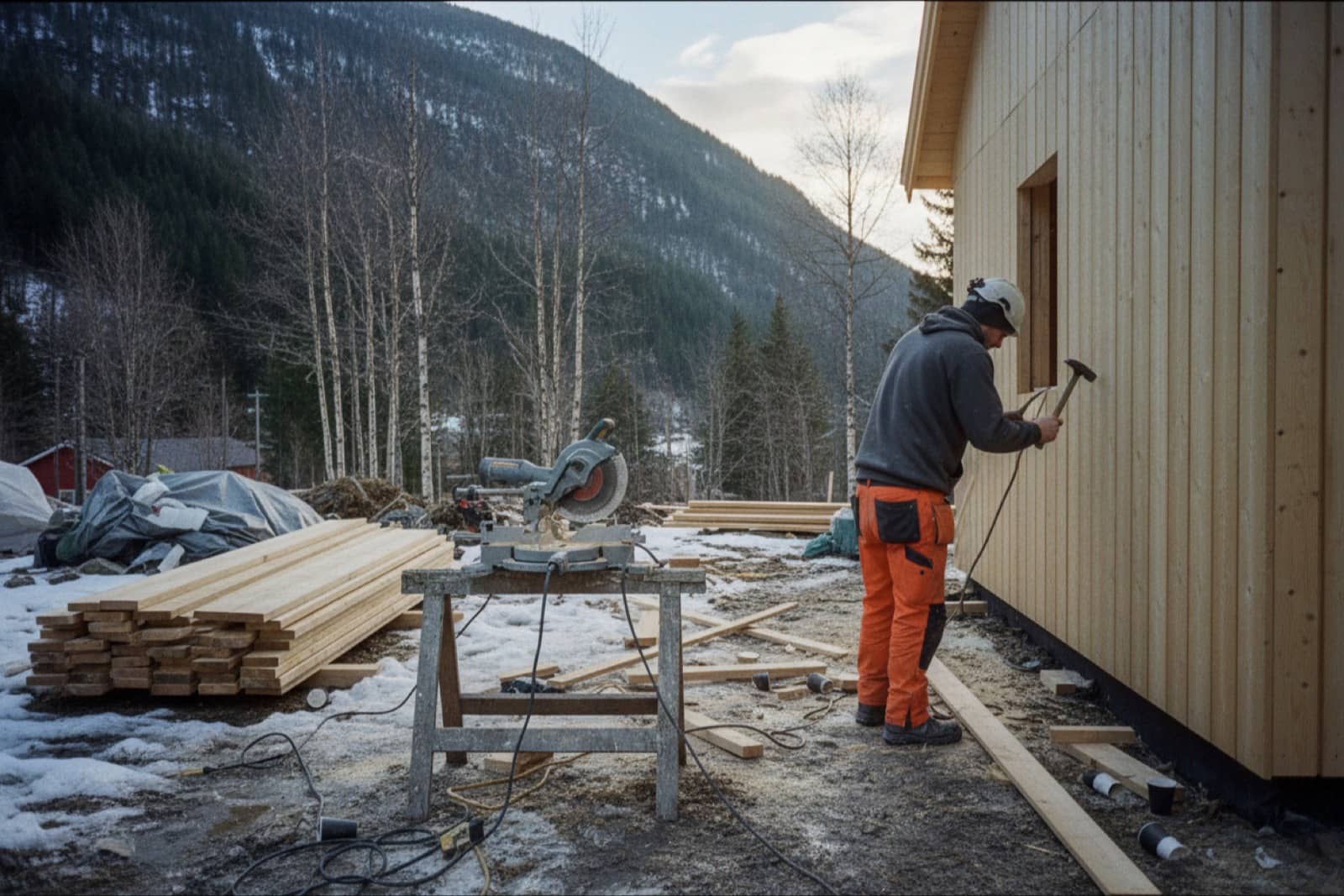
Most Norwegian housing is timber: wood-frame detached homes, row houses, and increasingly apartment blocks built in wood. Roof structures, exterior cladding and interior fit-out are carpenter work too. Where a site in Germany or the UK is dominated by masonry and concrete trades, a Norwegian residential site is dominated by carpenters.
For you that means two things. There's more carpentry work per project than you may be used to. And wood-frame experience transfers directly: if you've framed walls, set roof trusses or hung cladding at home, you'll recognise the work from the first day, just with Norwegian details and tighter tolerance culture.
Winter building: the season doesn't stop
Norwegian sites build all year. Shells go up under weather protection, scaffolds get tented and heated, and interior fit-out is scheduled into the darkest months. For a carpenter that means steady hours through winter rather than a seasonal gap, which is a real difference from much of Europe.
It also means working at minus temperatures sometimes. Employers provide winter gear and heated breaks; you provide the willingness. If you've only ever worked fair-weather seasons, factor that in honestly before applying.
Fagbrev: what your trade certificate is worth
What you need on site
- HMS card (HMS-kort), everyone, always
- Mandatory for every person on a Norwegian construction site. Your employer orders it once you and the company are registered, and it stays valid for 2 years. Without it you don't get past the gate.Source: Arbeidstilsynet, HSE cards for construction sites · 2026-08-08
Your rights on a Norwegian construction site
- Construction minimum wages are legally binding for everyone on site: 239.61 NOK/h from day one, 249 NOK/h after a year in the trade, 264.32 NOK/h with a trade certificate. Find your tier and compare it with your payslip.
- Overtime: at least +40% by law. Collective agreements often pay more, so check what your contract says.
- Holiday pay is 10.2% of your year's wages. It is not a bonus, it is your money, paid out the following year.
- Rest: at least 11 hours off per day and 35 hours per week.
- Housing deductions from your wages are only legal when agreed in writing and kept within the limits the law sets.
- You have the right to a written contract in a language you understand, before you travel.
- You never pay to get a job. Charging a worker a recruitment fee is illegal.
- If something is wrong, Arbeidstilsynet, the Norwegian Labour Inspection Authority, takes reports in English and anonymously. In construction the Fellesforbundet union can help too.
Rates and rules verified at the source: Arbeidstilsynet · 2026-08-08
Who actually builds in Norway
The names below are the large Norwegian contractors carpenters end up working for, directly or through subcontractors. This list exists so you can check who really builds where you are going.
- Veidekke
General contractor · Builds nationwide
- AF Gruppen
General contractor · Builds nationwide
- Skanska Norge
General contractor · Builds nationwide
- Peab Norge
General contractor · Builds nationwide
- Consto
General contractor · HQ in Tromsø
- HENT
General contractor · Builds nationwide
- Bravida Norge
Electrical and HVAC · Builds nationwide
- Caverion Norge
Electrical and HVAC · Builds nationwide
We don't claim to place workers with each of these companies. They are listed as verifiable market context, nothing more.
Reviews: how to check a Norwegian employer yourself
We don't publish made-up five-star testimonials, and you should treat anonymous "worker reviews" with care. Do this instead: look the employer up in the Norwegian registers, ask to talk to someone already on the crew, and compare the offer against the statutory rates on this page. As we collect real, signed accounts from people we've placed, we publish them, with their permission.
Carpenter jobs in Norway: FAQ
What is the hourly rate for a carpenter in Norway?
The statutory minimum on Norwegian sites is 264.32 NOK/h for a skilled carpenter (fagarbeider), 249 NOK/h after one year in the trade and 239.61 NOK/h as a starter. Experienced carpenters we place typically get 270–300 NOK/h, about €25–€27. At full time that's roughly 43,875–48,750 NOK gross a month before overtime.
How much does a construction worker earn in Norway?
Norwegian construction has legally binding minimum wages: 239.61 NOK/h with no experience, 249 NOK/h after a year in the sector and 264.32 NOK/h with a trade certificate. They apply to every worker on every site, whatever your nationality, because the rates are extended by law.
Is my carpentry qualification valid in Norway?
Norway's carpenter qualification is the fagbrev, and a foreign trade certificate counts when your employer recognises it as equivalent. Carpentry isn't a state-regulated trade, so no authority has to approve you before you work. Bring your certificate with an English translation, plus references; employers decide the rate tier based on those.
Are carpenters in demand in Norway?
Yes. Norway builds mostly in wood: detached homes, apartment blocks in timber, roof structures, interior fit-out. That makes carpentry the biggest single site trade, and employers ask us for experienced carpenters steadily. Documented wood-frame experience is the strongest card you can bring.
Can a US citizen get a job in Norway?
Honestly: not through us, and not easily. A US citizen needs a Norwegian employer to sponsor a residence permit for work through UDI before starting, and those permits mostly go to roles that can't be filled from the EU/EEA labour market. We only place EU and EEA citizens, who need no permit at all.
Do I need visa sponsorship for construction jobs in Norway?
If you're an EU or EEA citizen: no. Norway is in the EEA, so you can take a carpentry job without a visa, work permit or sponsorship. You register with the police once if you stay past three months. Non-EEA citizens need an employer-sponsored permit, which we don't arrange.
Which jobs are in demand in Norway?
In construction: carpenters, formwork carpenters, concrete workers, scaffolders and electricians come up most often in our employer conversations. Skilled trades with documented experience place fastest. Outside construction, fish processing, transport and healthcare recruit steadily.
Do carpenters work through the Norwegian winter?
Yes. Norwegian sites build year-round; winter is planned for, not paused for. Buildings go up under weather protection and tented scaffolds, and interior fit-out fills the darkest months. Expect proper winter clothing on the company, and expect to work at minus temperatures sometimes.
Do I need to speak Norwegian to work as a carpenter?
No. Basic English is enough in most crews, and many sites with foreign workers run in English. You also have the right to an employment contract in a language you understand, before you travel.
Is accommodation included with carpenter jobs in Norway?
Usually not, and you should get the housing terms in writing before you travel. The normal setup: the employer or we help you find a room, and you pay the rent yourself, typically 5,000-5,500 NOK a month. Norwegian law limits what can be deducted from wages for housing.
How much tax does a carpenter pay in Norway?
New foreign workers can use the PAYE scheme: a flat 25% deducted automatically, no tax return. On 270 NOK/h at full time, that leaves roughly 32,906 NOK net a month before overtime.
What tools does a carpenter bring to Norway?
Most carpenters bring their own hand tools and belt; machines and consumables come from the company. Requirements differ between employers, so ask before you travel and get the tool list in your contract.
Are there carpentry jobs in Norway right now?
Carpentry jobs open in waves, tied to the projects our partner companies win, so some weeks there are several and some weeks none. The live list on this page shows only what is open today, most often wood-frame housing and renovation around Tromsø. When it is empty, apply anyway with your experience and papers: a recognised trade certificate puts you on the 264.32 NOK/h skilled floor, and we come back to matching applications first when a project starts.
What happens after you apply
A chat with TANA
Our own AI, TANA, may start the conversation. It asks about your trade and the work you are after.
We read it and get in touch
Our team goes through your application and the chat. If a job fits, we contact you personally. If we do not get in touch right away, you stay on file and we may write a month or two later.
We put you forward
Your profile goes to the Norwegian employer and we set up the call.
Contract and travel
Your contract is with the Norwegian employer. We meet you in Norway and take you to your place.
Every application gets an answer within a month.
We're looking for carpenters for Norway
Send your CV with your wood-frame experience, your trade certificate if you have one, and photos of your work. We'll check your background and come back with concrete terms.